
You Think About an Old Friend, They Text You That Day — So Why Do Coincidences Happen?
You haven't heard from someone in two years. You think about them on a Tuesday morning for no reason at all, and by lunch there's a text from them sitting on your phone. Every instinct you have says that meant something. So why do coincidences happen, and why does your brain insist on treating them like messages?
The short version is that your brain is terrible at math and very good at feelings, and when those two fight, feelings win every time.
The Friend Who Texts You Back From Nowhere
Run the actual numbers on the old-friend thing. You've got maybe a hundred people who could plausibly text you on any given day. You think about a handful of them every day, some more than others. And most of them are going to resurface eventually, because that's what friends do.
So the odds of one of those overlapping on the same day are somewhere around a couple hundred to one. We didn't Google the exact figure, so don't quote us on it. But hold that next to the lottery, which runs around 300 million to one, and the gap is not close. It isn't even the same kind of number.
Your brain files them in the same drawer anyway. Not because it's bad at arithmetic in general, but because you're emotionally invested in the friend and you're not emotionally invested in a probability table. The feeling of significance does all the work, and the math never gets a vote.
Why Do Coincidences Happen? Sometimes 23 People Is Enough
Here's the one that breaks people. In a room of just 23 people, there's roughly a 50% chance that two of them share a birthday.
Twenty-three. Not a hundred and eighty. Most of us hear that and immediately start arguing, because 365 days feels enormous and 23 feels like nothing. The catch is that you're not comparing yourself against 22 other people. You're comparing every possible pair in the room, and there are 253 of those. That's where the odds hide.
It's probably the cleanest example there is of the gap between what probability actually says and what your gut swears is true. Try it at your next party. It works often enough to be annoying.
The Coin Doesn't Remember Anything
Flip a coin and get ten heads in a row. What's next?
Everyone says tails. Everyone is wrong. The coin has no memory, no sense of fairness, and no idea what it just did. Every flip is 50/50 forever, and the eleventh one doesn't care about the first ten.
The thing that trips people up is that there's a real principle buried underneath the wrong instinct. Flip a coin a million times and it does even out, sort of. You might still end up ten heads ahead, but ten out of a million is nothing, so it looks balanced. Do it ten times and that same ten-flip gap is the entire experiment. We take a rule that's true at enormous scale and apply it to a sample size of ten, then get annoyed when reality doesn't cooperate.
We're Running Really Old Software
None of this makes you dumb. It makes you a human being running equipment that was built for a completely different problem.
For most of our history, reading patterns was survival. Joey wandered off and got eaten by a saber-toothed cat, so nobody wanders off anymore. These berries killed two people, stop eating the berries. The water over there dried up last season, move the camp. Those streaks meant something, every single time, because nature isn't a series of independent random events. It has causes.
Then we built a world full of coin flips, lottery tickets, and slot machines, which have no causes at all, and we kept running the old pattern-detection software on top of it. That's the whole bug. Not stupidity. Just really good instincts pointed at the wrong century.
So Which Brain Do You Use?
If you've heard us argue that trusting your gut is one of the habits that makes people luckier, this might feel like a contradiction. It sort of is, and that's the interesting part.
Your gut is genuinely great at pattern recognition, because it's processing more information than you can consciously track. It's genuinely awful at independent random events, because it insists on finding a pattern whether one exists or not. Same equipment, opposite results, and the only real skill is knowing which situation you're standing in. A room full of people you might click with? Trust the gut. A roulette wheel that just came up red six times? Your gut is lying to you with total confidence.
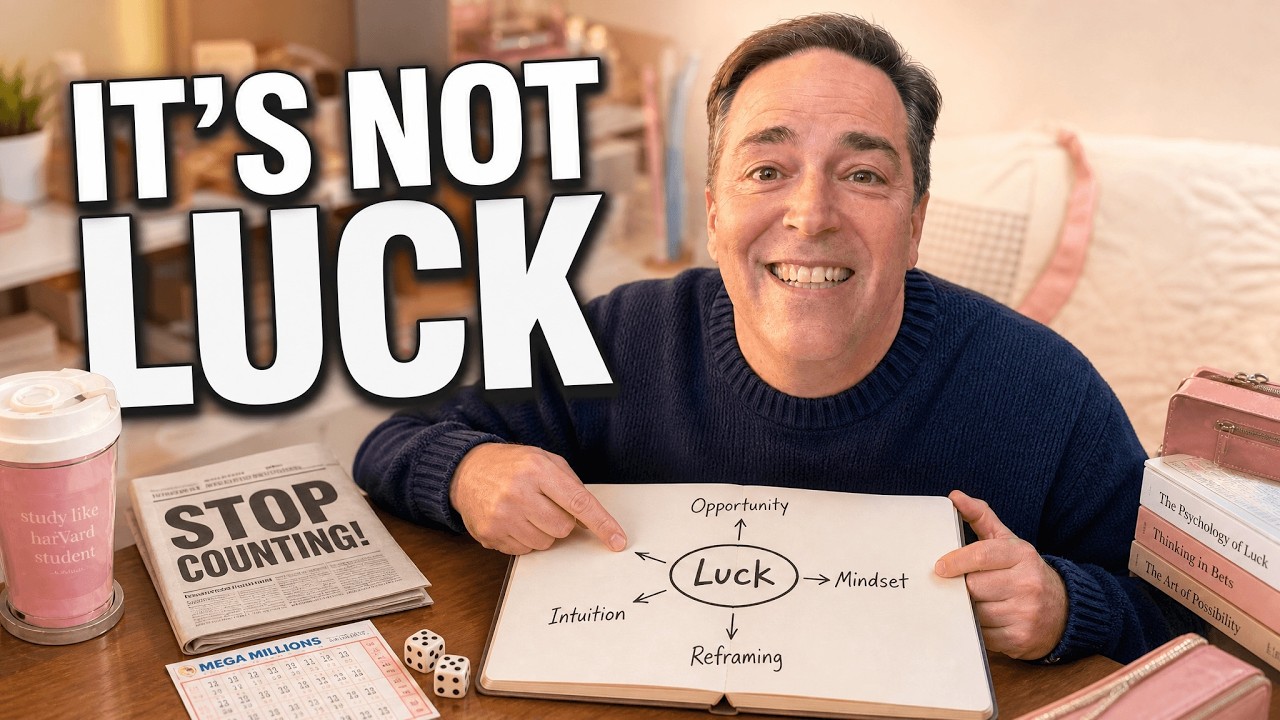
Episode 113 of Sorta Sophisticated runs this out further, including the psychologist who proved lucky people just notice more, the four habits that separate them from everybody else, and why survivorship bias makes success look like a lottery ticket when it usually isn't.
Watch the full episode here 👇 Lucky People Aren't Actually Luckier... Here's What They Do Differently (Episode 113)
