What Is Tip Creep? Why the Bagel Counter Now Wants 25%
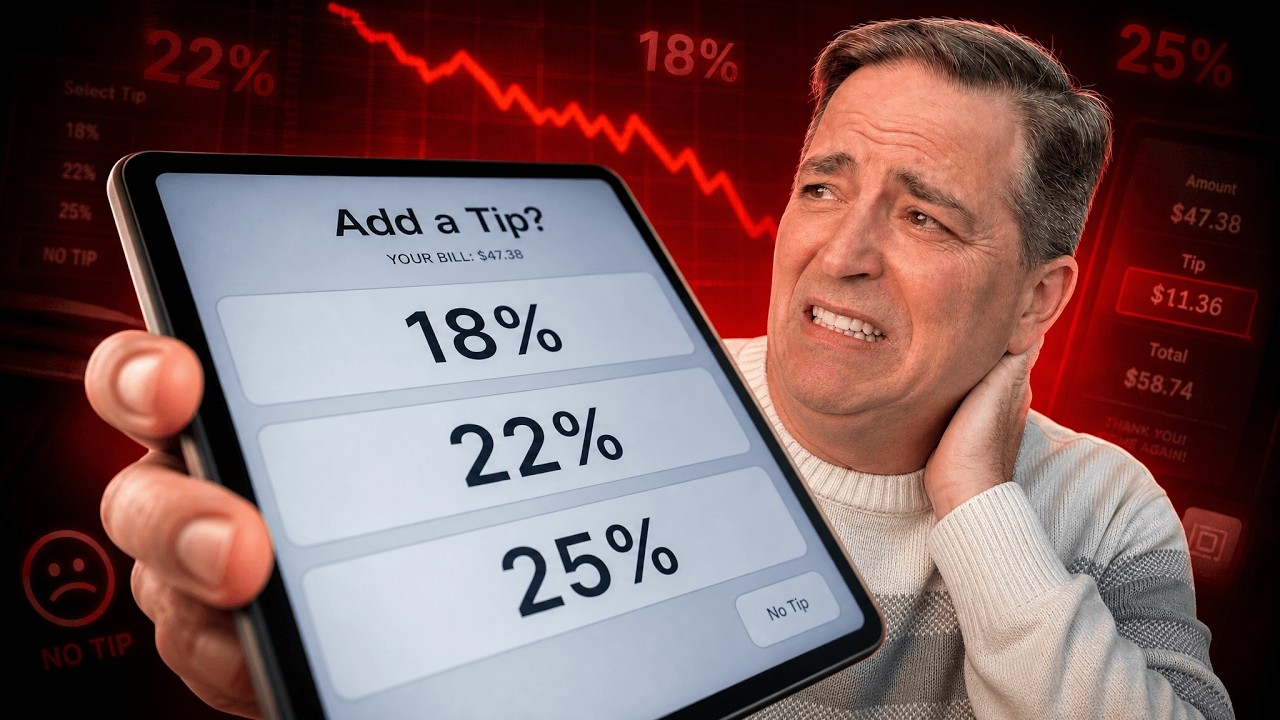
At eight o'clock on a Sunday morning, the cashier at Pete's bagel shop swiveled the iPad toward him: 18%, 20%, 25%, and a tiny "No tip" button tucked in the corner. He pressed it, walked out feeling judged anyway, and went home to figure out why. What is tip creep? It's the name for what happened at that counter: tip requests spreading into places that never used to ask for them, usually through preset percentages on a payment screen. About thirteen minutes into Episode 103 of Sorta Sophisticated, Pete came up with the phrase himself and asked Amanda if they could trademark it.
What Is Tip Creep, Exactly?
Tip creep is the steady expansion of tipping into purchases and businesses where it was never customary, such as coffee counters, bakeries, takeout windows, and self-checkout kiosks, driven mostly by digital payment screens that prompt every customer for a tip.
It's an informal label, not an economics term. Journalists picked it up around 2022 and 2023, when tip screens were showing up everywhere from stadiums to airport kiosks, and it usually travels with two cousins. "Tipflation" is the rise in what counts as a normal percentage. "Tipping fatigue" is how customers feel about both.
"Can We Coin That?"
Pete got there by way of business jargon. "In business, you heard scope creep," he said. "This is tip creep." Then he asked whether it was trademarkable. It isn't (reporters beat him to it), but landing on the same two words on his own shows how naturally the name fits.
His prediction for where it goes next was the Vons checkout, with a tip prompt for the person bagging your groceries. That one's a joke for now. The data says the feeling behind it is common. In an August 2023 survey of 11,945 U.S. adults, Pew Research Center found that 72% say tipping is expected in more places than it was five years earlier. Only about a third said it was extremely or very easy to know whether to tip at all.
The iPad Swivel
Pete blames the hardware more than the server. Before point-of-sale tablets from companies like Square and Toast, the tip happened in private: a paper receipt, a pen, a few minutes at the table to think it over. The jar on the counter was easy to walk past. The swivel screen puts the question in front of you while the person who just rang you up is standing there waiting.
Pete has a server friend at a lunch spot in Chino he goes to regularly, and they turn the hand-off into a bit. "Put it down. Walk away." His friend promises not to look, and Pete tells him it doesn't matter, because anyone can see where his finger is going. The friend's real view surprised him, though. Holding that screen in front of a customer and waiting is the part of the job he hates most.
Pete reached for a psychology term to explain the guilt: social facilitation, the idea that people behave differently when they think they're being watched. It's one of social psychology's oldest findings. Norman Triplett noticed in 1898 that cyclists rode faster racing against other people than alone. Most of that research is about how performance changes in front of an audience, and the tip screen puts the same pressure on generosity. Nobody is grading your tip, but you feel watched anyway.
Covid Moved the Baseline
Pete's theory is that Covid turned a slow creep into a jump. When restaurants were struggling, people tipped on takeout to keep their favorite places open, and Pete did it "like crazy." In his telling, that's when 15% quietly became 18%, and then 20% became the new 18%. The screens were already on the counter, ready to make those numbers the default.
That's Pete's read of his own habits rather than an industry figure, but the Pew survey shows where the line sits now. Ninety-two percent of Americans say they always or often tip at a sit-down restaurant. Only 25% say the same about buying coffee. Forty percent oppose suggested tip amounts on bills and screens, while 24% favor them. Tip creep happens in the gap between those numbers: the screen asks at the coffee counter as if it were a sit-down dinner, and most people don't think it is.
Pete's Line, Amanda's 10%
Pete was careful about where he stands. His complaint is the iPad shoved at him after someone did their regular job, and he wanted servers who work hard to know he's not coming for them. A busy server who stops to say "I know I haven't gotten to you yet" buys a lot of patience from him.
Amanda had already landed somewhere simpler. She grew up in a culture where tipping wasn't expected, she'll ask a restaurant to change an automatic 18% if the service wasn't worth it, and she said on the episode that she's moving to 10%. The swivel screen doesn't move her. "I was just raised culturally different," she told Pete, who called her one in a billion.
The Screen Is Asking a Question
The episode ends with permission rather than a rule. Amanda's closing advice: the next time the screen flips around, take one second "not to feel bad, but just to make an actual decision instead of it just being a reflex." Good service gets a good tip. A drip coffee handed over a counter is your call. The housekeeper you never saw might get $5 and a note on the pillow.
Tip creep works because the screen turns a choice into a reflex, and the fix is to treat it as a question again. Or, as Amanda put it in the last line of the show: "Stop letting a touchscreen tell you who you are."
---
Episode 103 of Sorta Sophisticated, "The Guilt Screen: How America Turned Gratitude Into a Transaction," covers the 1916 book that called tipping a corruption of American values, and the federal minimum wage for tipped workers, which hasn't moved since 1991. Stay for the Cornell research on what actually raises a tip. Squatting at the table works, and so does a light touch on the shoulder, which Pete's kids have banned him from trying.
Hear the full episode here 👇 The Guilt Screen: How America Turned Gratitude Into a Transaction (Episode 103)
