What Is the Circle of Control? The Three-Bucket Method for People Who Worry About Everything
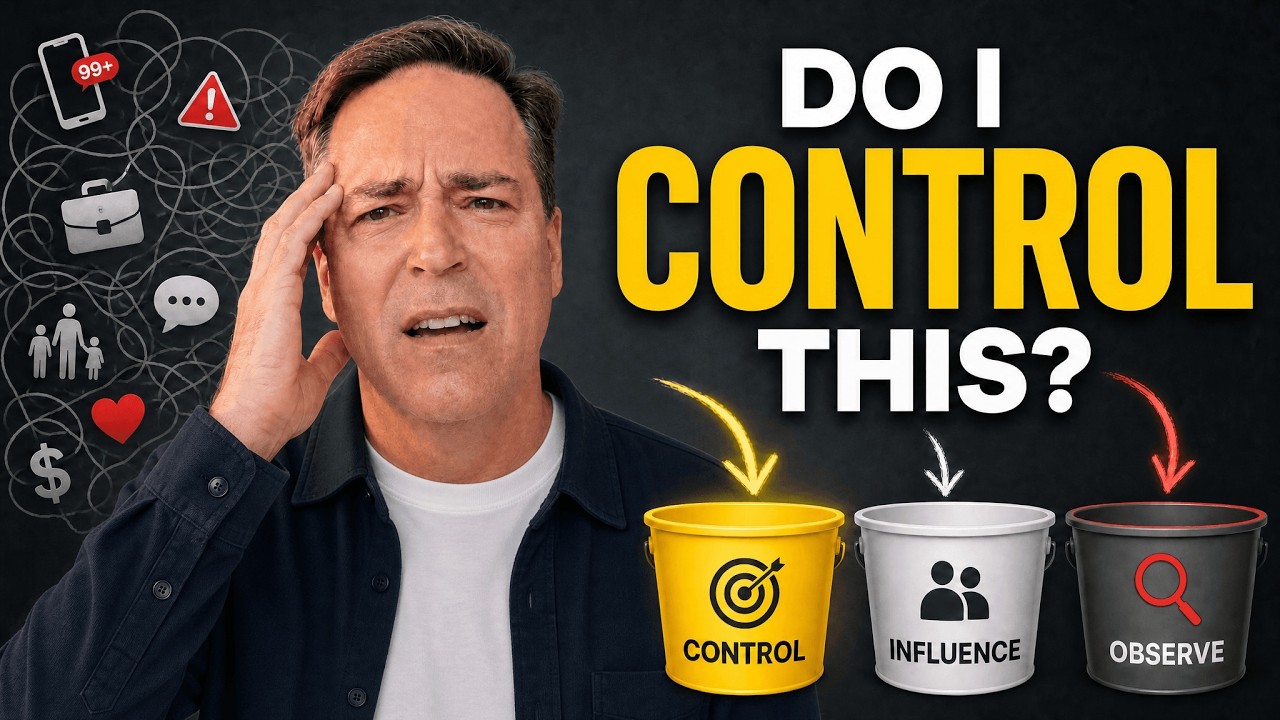
Pete hands out the three-bucket exercise as the episode's only homework, and then, about a minute later, grades himself a D at his own system. So what is the circle of control? It's a sorting system for worry: everything competing for your attention goes into one of three buckets — what you control, what you influence, and what you can only observe. The D is the most useful thing in the segment, because a framework whose own author is losing to it tells you exactly where the hard part is hiding.
What Is the Circle of Control, Exactly?
The circle of control is a model, popularized by Stephen Covey in The 7 Habits of Highly Effective People (1989), that sorts everything you think about into concentric rings — a circle of control (things you directly decide), a circle of influence (things you can move but not decide), and a circle of concern (everything else) — on the principle that attention spent in the outer ring produces nothing but stress.
Covey's argument was about where proactive people put their energy. Focus on the inner rings and your influence grows. Focus on the outer ring and it shrinks, because worry isn't an action and the world doesn't respond to it.
The show's version keeps the three rings but renames the outer one, and that rename does real work.
Bucket One: The Stuff That's Entirely On You
"Your health, your habits, your effort, how kind you are to people," Pete lists off. "That's entirely on you."
This is the bucket that's supposed to get the majority of your time, and the bucket almost nobody fills. Pete's test for it is embarrassingly simple, and he runs it on Amanda live: Are you working out? (No.) Are you eating right? (Yes.) That's the whole audit. Two questions, both of which you can answer without arguing, because things you control don't come with excuses attached. That's what makes them bucket one.
Amanda's response when Pete tries to move on to the second category is the funniest line in the segment and also the most honest: "Still working on number one."
Bucket Two: Where Worrying Gets Mistaken for Doing
The influence bucket is your kids, your friendships, your community, your employees. As Amanda puts it, it's anywhere "you have a voice in someone else's life."
The rule Pete attaches to this one is the sharpest idea in the episode. Bucket two is about action, not feeling. "If your kid's struggling, worrying about it — oh, my God, I spent my life worrying about it — doesn't move the needle, like, at all."
The reframe he gives is a swap of one question for another. Not how do I feel about this? but what can I do about it today? What can I do about it this week? His own example is his siblings: he doesn't want to think harder about the relationship, he wants to text them more often. The trap in this bucket is that worrying about someone feels almost identical to helping them, right up until you check what actually got done.
Bucket Three: You Don't Delete It, You Time-Box It
Wars, elections, the stock market, celebrity drama, the weather, hurricanes, strangers online rage-baiting you. "This is where everybody gets stuck," Pete says. "This is the things people obsess over. This is social media."
Standard advice about the outer circle is to stay out of it. Pete doesn't say that, and this is where the show's version departs from the textbook. His instruction is to give it a window instead. Fifteen minutes in the morning, thirty at night — pick a number, open the news app, and when the window closes, shut it down.
"You're not trying to avoid it," he says. "You're trying to only give it limited space."
That's a meaningfully different instruction, and a more usable one, because "stop caring about the news" is advice nobody has ever successfully followed. A time limit is a thing you can actually do. Amanda's objection is the one every reader will have — "it's easier said than done" — and Pete doesn't argue: "No, it's totally easier said than done. Tell me about it."
He also grades himself out loud. The observe bucket is "the hardest to let go by far for me." A framework whose author admits he's losing to it is more trustworthy than one that pretends otherwise.
The Homework Is One Day of Sorting
The assignment at the end of the episode is deliberately small, and Pete is insistent that it stay small. "Honestly, just start with the three buckets. That's all I would do. No other work. Wake up in the morning, sort one day's worth of worry into control, influence, observe and see how lopsided it is. That's the whole homework assignment."
There's no system to set up and nothing to install. You sort one day and then look at how it came out.
The lopsidedness is the point. Most people already suspect where their attention goes, but almost nobody has actually counted, and sorting one ordinary day turns a vague feeling into a number you can't argue with.
Why a Sorting System Beats Willpower
The reason this works better than resolving to worry less is that it doesn't ask you to feel differently. It asks you to file something. When a thought arrives, it gets a category, and the category tells you what to do with it: act on it, do something small about it, or put it in the window and get back to your life.
Amanda asks the question the whole framework hinges on — if it's in the third category, do I just leave it in the bucket? Yes. That's the part people cheat on, and she says so immediately: "Because I don't like that bucket."
Nobody does. It's the bucket that takes the most attention and gives back the least, which is exactly why leaving things in it feels like giving up rather than like winning.
As Amanda puts it in the episode's closing recap, attention has an opportunity cost. Every yes to bucket three is a no to your actual life, and you don't get those units back.
Episode 117 of Sorta Sophisticated is about the one thing you actually own and how cheaply most of us hand it over. Also in there: the basketball-passing experiment where half the viewers miss a gorilla walking straight through the frame, and why a brain built for a village of 150 people still treats a hurricane 2,000 miles away as a local emergency.
Hear the full episode here 👇 Your Attention Is The One Thing That You Actually Own (Episode 117)
Or watch it on YouTube 👀 Overthinking Everything? Try This 3-Bucket Method (Episode 117)
