
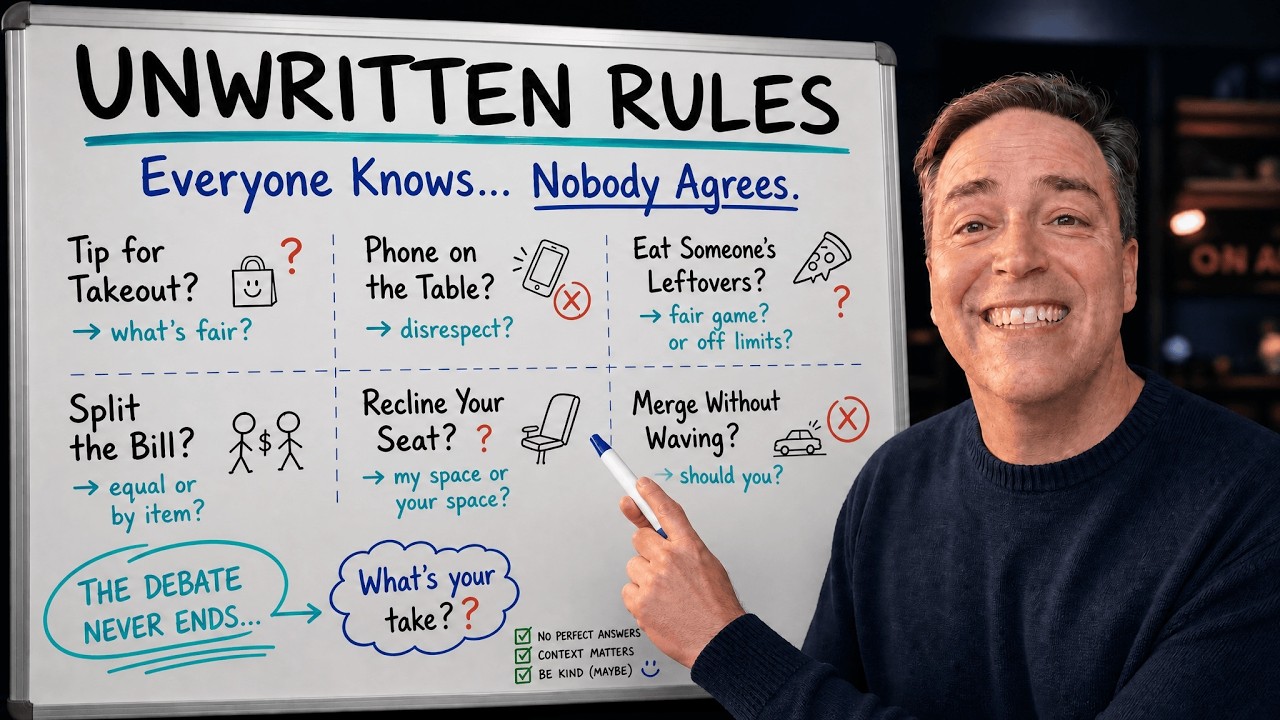
What Is Dunbar's Number? The 150-Person Ceiling That Explains Every Unwritten Rule You Follow
Pete left a dinner where he'd spent half the meal arguing with friends about how much to tip, got in his car, and someone merged in front of him without waving. The thought he had driving home was not a normal thought. It was: do I actually own the space in front of my car? Nobody wrote that down. Nobody voted on it. He was furious anyway. The closest thing science has to an explanation is Dunbar's number — the finding that one human brain can carry only about 150 stable relationships, and that once your world is bigger than that, you stop being able to handle people by name and start handling them by rule.
That's Episode 112 in one paragraph. The rest of the episode is Pete and Amanda fighting about pool chairs.
What Is Dunbar's Number, Exactly?
Dunbar's number is the proposed cognitive limit — roughly 150 — on how many people any one person can maintain a genuine, stable social relationship with at the same time.
Dunbar's own informal test for whether someone is inside your 150: if you bumped into them in a bar, would you feel comfortable joining them uninvited? That's a higher bar than recognizing a name or nodding at a face. It means you're tracking their life.
The number comes from British anthropologist and evolutionary psychologist Robin Dunbar, who published "Neocortex size as a constraint on group size in primates" in the Journal of Human Evolution in 1992. Dunbar had been comparing primate species and noticed that the size of a species' neocortex predicted the size of the troop it lived in. Bigger social processor, bigger group. He drew the regression line, plugged in the human brain, and got about 150. He built the argument out in Behavioral and Brain Sciences in 1993 and then wrote the whole book, Grooming, Gossip and the Evolution of Language, in 1996.
So the number was never counted. It was extrapolated. Hold onto that, because it matters later.
Your Social Life Comes in Rings, and Each One Is Roughly Triple the Last
The 150 is the famous figure, but Dunbar's model is layered: about 5 people in the innermost ring, then 15, then 50, then 150, then 500, then 1,500 faces you could put a name to. Each ring is roughly three times the one inside it, and each one costs less of you than the last.
Amanda got to the same structure on the podcast without the vocabulary, and faster. Pete asked when it's too late to say happy birthday to someone whose birthday you blew past. His instinct was to answer in units of time — a week, a month, some cutoff. Amanda said it has nothing to do with time. It depends which layer of the onion the person is in. Inner circle, you apologize forever. Outer circle, you were never going to say it anyway.
The same thing happened with weddings. Pete has been getting invited to a lot of them lately, mostly his friends' kids, mostly out of state, and wanted a rule for which ones he's obligated to fly to. Amanda's barometer: would you tell this person if something was happening to you medically? Pete's response was, roughly, damn it, then I have to go.
The Hutterites Have Been Running This Experiment for Centuries
The reason 150 keeps getting cited isn't the regression line. It's that the number keeps showing up in places nobody derived it.
Dunbar pointed to Hutterite colonies, which have long split themselves in two as they approach 150 members — deliberately, on the logic that past that size you can no longer run a community on personal obligation and reputation alone, and you'd have to install a hierarchy and enforcement. W.L. Gore & Associates, the company behind Gore-Tex, capped its plants around the same headcount and built a new one next door rather than let one grow past it; Malcolm Gladwell popularized that story in The Tipping Point in 2000. The Swedish Tax Authority reorganized its offices around the figure.
None of those groups needed a neocortex study. They noticed that something breaks at a certain size and put a wall there.
Under 150, You Use a Name. Over 150, You Need a Rule.
The encyclopedia entry stops at the number. Pete's episode does the part that comes after it.
In a group under 150, enforcement is personal. Everyone knows who took the last coffee and didn't make more, and the cost of doing it is that everyone knows. You don't need a written rule about the office fridge because you can look directly at the guy who ate the leftovers. Reputation does the whole job.
Above 150, that machinery stops working, and the enforcement has to move somewhere else. It moves into the unwritten rule — a norm nobody taught you, nobody voted on, and everybody somehow absorbed. You don't know the man merging in front of you on the freeway. You will never see him again. So instead of a name, there's a wave, and the wave carries all the weight that knowing his name used to carry.
That's why the violations feel wildly out of proportion to the offense. The guy at the Kauai pool who puts a towel on six chairs at 7 a.m. and disappears has cost you nothing measurable. Pete admits he isn't even planning to sit at the pool. He's still angry. Amanda pushed on exactly this: is there an expectation that you own that chair? There isn't. There's no law, no sign, no proctor. There's just a rule that everyone knows and nobody can point to.
The Number Has Its Own Skeptics, and They Have a Point
The 150 gets quoted like a physical constant, and it isn't one.
In 2021, Patrik Lindenfors, Andreas Wartel and Johan Lind published "'Dunbar's number' deconstructed" in Biology Letters. They reran the primate analysis with newer datasets and different statistical methods and got wildly different answers — average group sizes somewhere between 69 and 109 with one method, 16 to 42 with another. The killer wasn't the estimates, it was the confidence intervals: 4 to 520, and 2 to 336. Their conclusion was that specifying any single number from this kind of extrapolation is futile.
Dunbar has pushed back, arguing the observed group sizes in the real world keep landing near 150 regardless of what the regression does. Both things can be true. Treat 150 as a well-traveled estimate of an order of magnitude, not a measurement — the human social world runs to hundreds, not thousands, and definitely not to your follower count.
Nobody Called a Meeting About Any of This
What Pete found in the research surprised him, because he went in assuming there was nothing underneath any of this. He came out with a theory about why a stranger's driving posture can ruin a Tuesday.
The rules that govern the pool chair and the merge lane and the plate you have to return aren't arbitrary social anxiety. They're what a species with a 150-person brain built so it could live in cities of ten million. Nobody voted. Nobody circulated a memo. Millions of us coordinate all day on rules that exist in exactly one place, which is inside the people following them. Pete's word for it at the end of the episode was architecture, and it's the right one.
Amanda put the sharpest version of it at the end of the episode: the revealing question isn't whether you know the rule. It's what your gut does when someone breaks it. That reaction is where the rule actually lives.
Episode 112 of Sorta Sophisticated is Pete showing up with five minutes of research and a list of arguments to pick, which is exactly as good as it sounds. It gets into the parts that didn't fit here: Pete's 18-hour statute of limitations on his kids' leftovers, Amanda's three-strikes-and-you're-off-the-island rule for people who flake on invitations, and why bringing a hostess gift in Japan can be the rude move.
Hear the full episode here 👇 Unwritten and Non-Negotiable: Who Made These Rules? (Episode 112)
