
Nobody Knows What to Say After Grief — Here's How to Help Someone Who Is Grieving
Three years ago this month, Pete's wife Gabby died. Since then he's watched a lot of people try to figure out what to say to him and get it wrong, and none of them were bad people. There's just no manual. So if you've ever stood in front of a grieving friend rehearsing a sentence in your head, here's what three years on the other side of it taught us about how to help someone who is grieving.
That gap is the strange part. We have manuals for getting married. We have manuals for having a baby. Your wife dies when you're fifty and everyone around you is improvising.
The Five Stages Were Never About You
Start by throwing out the thing everybody thinks they already know. Elizabeth Kübler-Ross published the five stages of grief in 1969, and she built them by sitting with terminally ill patients making peace with their own deaths. They were never a model for the people left behind.
Somewhere along the way that list got repurposed into a universal checklist for the bereaved, and it's been quietly misleading people ever since. Denial, anger, bargaining, depression, acceptance reads like a progress bar. Grief doesn't have a progress bar. It's closer to a table of contents than a path, and nobody hands you the page numbers.
Talkers and Doers, and Why They Drive Each Other Crazy
Here's the piece of research that would have changed things if Pete had found it on day one. Grief researchers split people into two rough styles. Intuitive grievers process out loud, through crying and talking and feeling it in real time. Instrumental grievers process through action, through their hands, through staying busy. Most people are a blend with one dominant setting.
The catch is that the two styles tend to find each other suspicious. If you're a talker, the doer in your family looks like they're dodging it. If you're a doer, the talker looks like they're marinating in it.
Pete is a talker, roughly 85% of the time. His family runs both ways: Ruth is another talker, and then there are the doers, like Luke, who doesn't especially want to discuss it, and Paul, who processes by making music and hiking. Once Pete could actually name the two styles, his son going quiet stopped reading as distance and started reading as a different language. Nobody in that house was grieving wrong. They were grieving in translation.
Stop Trying to Fix It
The most common mistake by a mile is treating a grieving person like a problem that has a solution.
People show up with a script. They redirect, they reassure, they reach for the silver lining, they explain that it was somehow meant to be. All of it lands the same way: as evidence that the person standing in front of you has decided you're broken. Pete's take on that is blunt. He doesn't feel broken. He just gets the distinct impression the world has already made up its mind that he is.
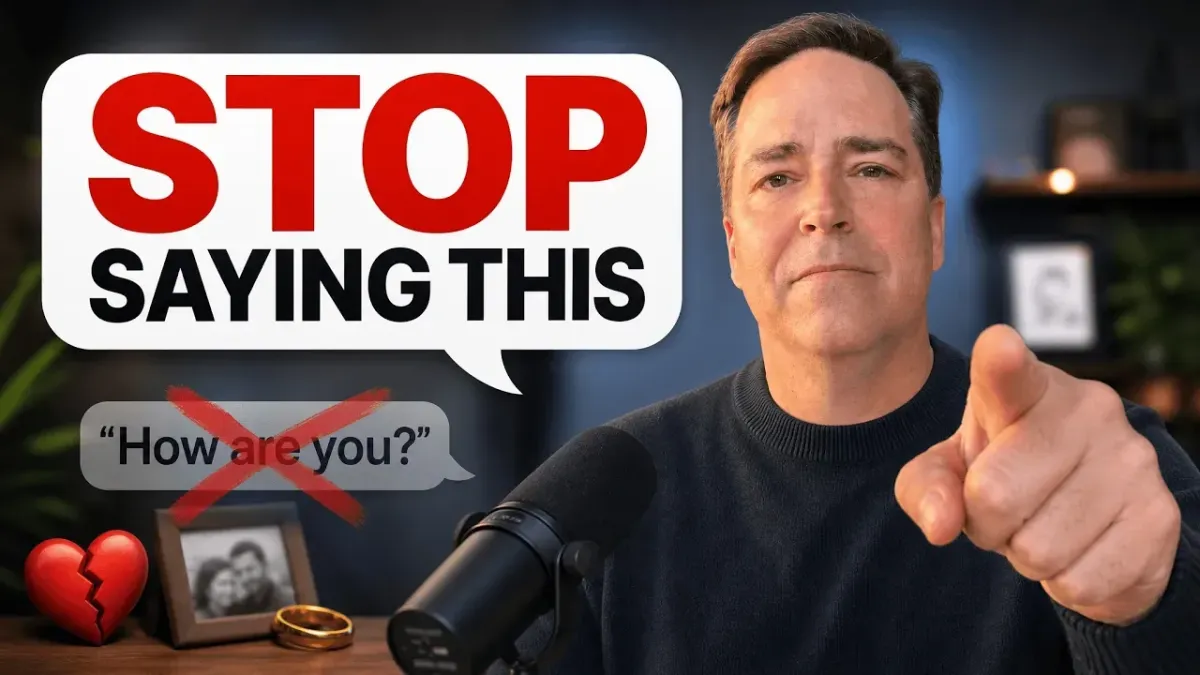
There's also the "how are you doing?" problem. Asked once, it's kind. Asked constantly, it quietly hands the grieving person a job. Now they have to manage your concern, produce an update, and reassure you, possibly on a day they were doing fine until you asked.
Try the opposite. Instead of asking a question, tell a story. I drove past the sushi place and thought about Gabby. I had a dream about her last week. That asks nothing of them. It isn't a test they have to pass. It's just proof that the person they lost is still real to somebody else, which is most of what they wanted from you anyway.
It Doesn't Get Easier. It Gets Different.
Kübler-Ross got one thing exactly right: there's no timeline. But "time heals" is a copout, and so is assuming year three is easier than year one.
The worst days aren't the ones you'd guess either. Not the day she died, which Pete knew was coming. Not the funeral, which he'd had time to prepare for. The worst days were ambushes. Watching his son walk across a stage at Loyola Marymount, looking up at the bell tower and seeing the dorm where he and Gabby started dating. Watching Ruth graduate at UCI, then going home and finding a photo of the two of them in graduation gowns at seventeen, from the same high school where they'd met at fourteen. Grief mostly ignores the anniversaries you brace for. It waits in an ordinary Tuesday.
The other thing nobody warns you about is that the griever changes too. A real part of Pete died when Gabby did, and old friends keep reaching for the version of him that doesn't exist anymore, because that's the guy they knew for thirty years. It isn't their fault. But it means every relationship has to get renegotiated at exactly the moment he has the least energy to do it. Some of those he pours energy into. Some he's quietly let go of, and that's allowed.
How to Help Someone Who Is Grieving, In Practice
The honest answer is that you cannot know in advance what any grieving person wants, so stop torturing yourself trying to guess. Grief researchers have a line for this: grief is like a fingerprint. No two are alike, even for the same kind of loss. Which means every tip, script, and stage chart ever written is statistically wrong for somebody.
So ask. "What are you looking for? How can I show up for you?" beats any perfect sentence, and not because the answer is going to be brilliant. Because the question itself is proof you're paying attention instead of performing.
Then just be whoever you already were to them. Amanda has shown up to a small podcast studio every week for two and a half years. That isn't a grief strategy, that's the entire thing. Being around on the other 364 days counts for more than finding the right words on the anniversary. The friends who help most are rarely the ones who came up with something profound. They're the ones who kept showing up and stayed quiet long enough to actually listen.
Episode 114 of Sorta Sophisticated is Pete handing the mic to Amanda and letting her interview him, which is not a format we've tried before. It gets into the parts that didn't fit here: why faith is the only way he still feels connected to Gabby, what brain scans show about grief behaving more like withdrawal than sadness, and the kind of grief nobody sends flowers for.
Hear the full episode here 👇 Nobody Knows What to Say After Grief (Here's What Actually Helps) (Episode 114)
