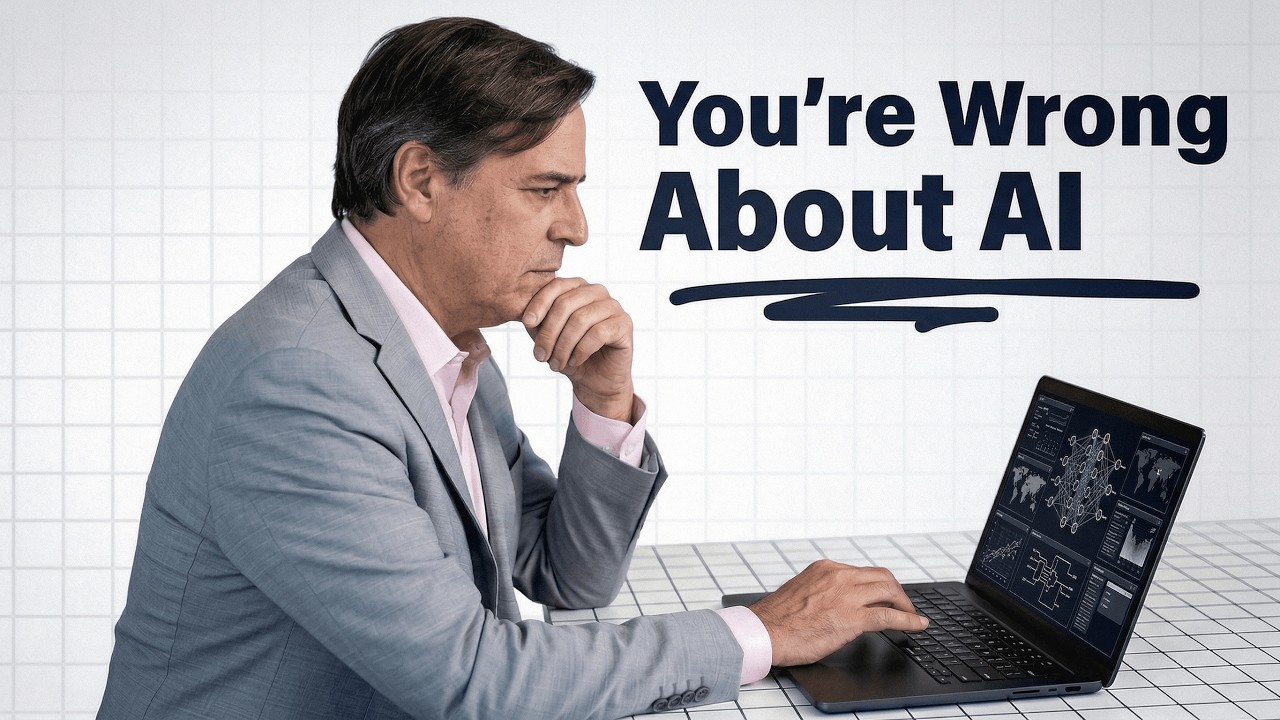
You're Thinking About AI All Wrong (And History Backs It Up)
The robot takeover that keeps not arriving
Open any feed and someone is insisting that artificial intelligence is about to swallow your job, your industry, and maybe civilization for dessert. On this episode of Sorta Sophisticated, Pete decided to argue the opposite: AI isn’t the first “job killer.” It’s roughly the hundredth. Amanda, for the record, spent most of the episode convinced it’s “going to take over and kill us all.”
That tension is the whole point. The honest answer lives somewhere between Pete’s optimism and Amanda’s dread, and the only way to find it is to do the one thing panic never allows: zoom out.
Word of the week: truculent
Before the history lesson, a little vocabulary. Truculent means aggressively defiant or eager to argue, combative in a way that simmers inside you rather than just shouting outward. It comes from the Latin truculentus, meaning fierce or savage. A useful word for the comment section of literally any AI debate.
We’ve panicked about this exact thing before
Here’s Pete’s core argument. Every time a technology removes friction from the system, the same movie plays:
Something new arrives.
Everyone panics and predicts the end of work.
We adapt.
The new tool creates more jobs and ideas than it destroyed.
Take the printing press. Around 1450, Johannes Gutenberg’s machine started producing pages faster than any scribe could dream of. The scribes were terrified, and they weren’t wrong to be: their specific jobs really did disappear. But look at what rushed in to replace them. Authors. Publishers. Editors. Librarians. Entire libraries. Reading stopped being a luxury reserved for nobles and the wealthy. Universities formed because suddenly people could get educated. The Protestant Reformation happened partly because ordinary people could finally read for themselves instead of taking a single authority’s word as final.
Sound familiar? Swap “printing press” for “social media” and you’ve described the last fifteen years.
The steam engine told the same story. In the late 1700s and early 1800s, workers were so frightened of machines replacing manual labor that some literally smashed them with sledgehammers. And yes, jobs vanished. But railroads, engineers, mechanics, manufacturers, and entire cities were born out of that same disruption.
The one thing AI can’t do
Amanda’s pushback is the strongest part of the conversation, and it deserves a real answer. AI, she points out, is genuinely different. It can write an email that sounds like you. It can build a marketing plan. It can answer almost anything. So how is it just another printing press?
Pete’s reply: AI can produce, but it can’t decide. It can generate a thousand options; it cannot tell you which one is right. The thing great leaders, doctors, lawyers, and business owners trade on isn’t access to information. It’s judgment. Discernment. The gut call when the data points in two directions at once. AI can play chess forty moves ahead and still have no idea it’s playing chess.
So the jobs that thrive won’t be the ones with the most information. They’ll be the ones that know what to do with it. As Pete puts it, the future belongs to the questioners, the people who interrogate the output instead of swallowing it.
So what actually wins?
The episode lands on a surprisingly practical filter. In an AI world, two groups are in trouble: the malicious and the lazy. Everyone else has room to thrive if they lean into a few things, getting good at asking sharp questions, protecting their judgment, building real human networks, and specializing in something specific enough that a “vanilla” machine answer can’t replace it. Average is what dies. Differentiation is the new job security.
There’s also a whole category of jobs that doesn’t exist yet. Pete’s bet: within a decade, “AI ethics management” will be a legitimate college major, and a small army of people will be employed essentially as the ethical police, the cybersecurity layer for a world where you can no longer assume the face on your screen is real.
Fun facts to sound sorta sophisticated
The term “artificial intelligence” was coined at a conference at Dartmouth in 1956, way before the internet. The researchers there genuinely believed they’d reach human-level machine intelligence by the end of that same summer. Seventy years later, we’re still working on it.
The first chatbot, Eliza, was built in 1966. All she really did was rephrase your statements back as questions (“I’m feeling anxious” becomes “Why are you feeling anxious?”), and people still got emotionally attached.
AI doesn’t actually “know” anything. When it tells you Paris is the capital of France, it isn’t recalling a fact, it’s making an extremely educated statistical guess based on seeing that pattern billions of times. Powerful math, not understanding.
AI has already helped radiologists catch breast cancers in mammograms that trained humans initially missed, a reminder that “tool,” used well, can mean lives saved.
The takeaway
This isn’t a robot-takeover story. It’s a pattern story. From medieval monks panicking over the printing press to modern workers side-eyeing ChatGPT, technology shifts, humans adapt, and value migrates from output to judgment. The winners won’t be the people who resist AI or the ones who blindly worship it. They’ll be the ones who collaborate with it strategically and keep doing the thinking themselves.
If the robot is doing all the work, you’d better be the one doing all the thinking.
Watch here:
Want the full debate, including Amanda’s excellent refusal to be convinced? Listen to this episode of Sorta Sophisticated, and if it made you think, subscribe and share it with someone who still believes AI is just a fancy spell-checker.
