
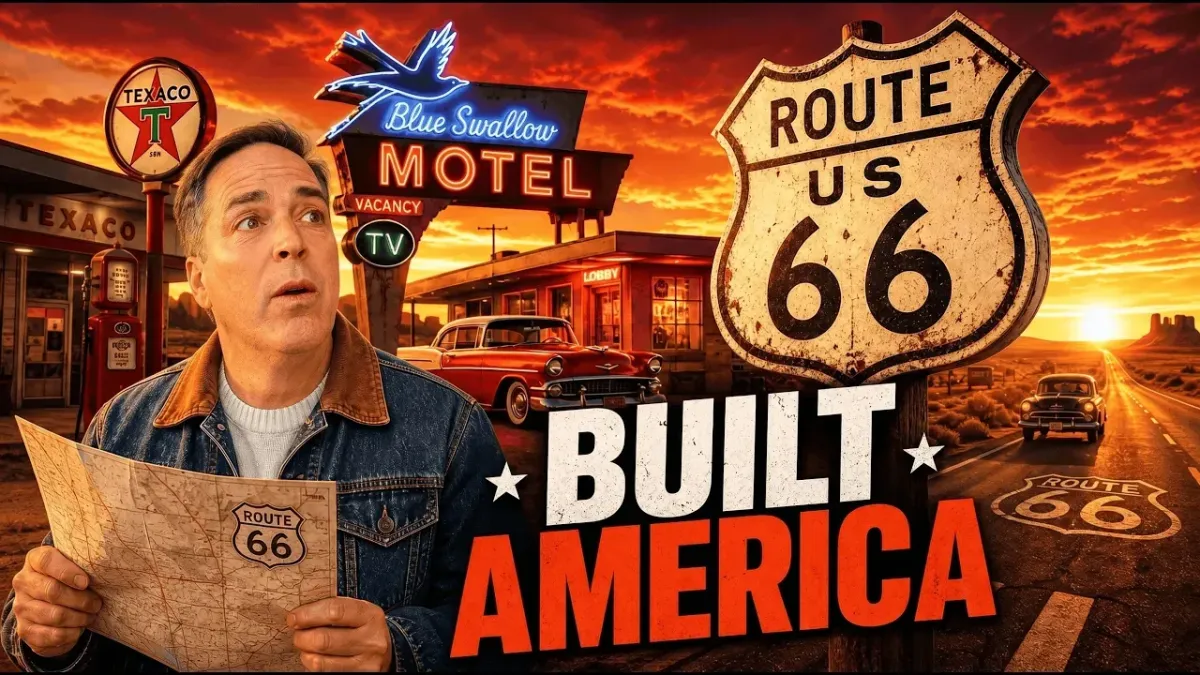
Route 66 Was Decommissioned in 1985 — So Why Does the Whole World Still Drive It?
Here’s a strange piece of American trivia: the most famous highway in the United States isn’t officially a highway at all. Route 66 was decommissioned in 1985 — removed from the federal highway map entirely. And yet today it’s one of the most visited tourist destinations in the world, and the majority of the people driving it aren’t even American. So what happened?
How a Road Becomes a Myth
By the 1950s, Route 66 had already carried Dust Bowl migrants west, moved soldiers and supplies through World War II, and launched the great American family road trip. But two pieces of pop culture turned it from a useful road into a legend.
First came Jack Kerouac. His 1957 autobiographical novel On the Road became the anthem of the Beat Generation — the counterculture movement that rejected conformity before the hippies of the '60s or the punks of the '70s existed. Here’s the fun part: the book isn’t actually about Route 66. It barely mentions it. It’s about the idea of heading west with no plan and no destination — the journey to nowhere as the whole point. But the public fused that spirit of freedom with the era’s most famous westbound highway, and the mythology stuck.
Then came television. In 1960, CBS launched a show literally called Route 66 — two guys in a Corvette drifting from small town to small town, finding adventure and hijinks for four seasons. Between Kerouac’s book and prime-time TV, Route 66 stopped being infrastructure and became an idea: freedom, reinvention, and the promise that if your life isn’t working, you can always drive west and start over. Which might be the most American idea there ever was.
The Interstate Killed the Radio Star
Ironically, the thing that made Route 66 obsolete was the fulfillment of the same vision that created it. In 1956, President Dwight D. Eisenhower signed the Federal-Aid Highway Act, launching the interstate highway system — arguably one of the most complicated engineering projects in human history. The new interstates were faster, straighter, and bypassed the small towns entirely.
One by one, the towns along Route 66 withered. Motels closed. Gas stations shuttered. Diners went dark. Travelers grabbed their services off interstate exits instead, and in 1985 the government made it official: Route 66 was decommissioned and removed from the federal highway system altogether.
Why the World Won’t Let It Die
And then something very American happened. The moment the road was declared dead, people decided it couldn’t be. A preservation movement sprang up, sections of the route were saved, and nostalgia did what nostalgia does — it made the whole thing more iconic than ever.
Today, the most devoted Route 66 pilgrims come from overseas, with Germany and Japan topping the list. For international travelers, Route 66 is America in its purest form — cowboys, the frontier, neon diners, and open horizon. It’s their bullet train, their Autobahn: the one thing you have to experience to say you’ve really touched the culture.
The road is still out there — cracked and faded in places, weeds pushing through the asphalt, signs nobody has reprinted in decades. But it exists. And maybe that’s the point: some roads don’t need to be the fastest way to get somewhere. They just need to exist, so you know the option is there.
For the full conversation — including why the road ends at the Santa Monica Pier and what that meant to the millions who drove it — listen to Episode 109 of Sorta Sophisticated: “America’s Most Iconic Road Almost Nobody Drives Anymore.” New episodes every Wednesday.
Watch the full episode here 👇
America’s Most Iconic Road Almost Nobody Drives Anymore (Episode 109)
