Why Is Nitroglycerin in Dynamite and Heart Medicine? Alfred Nobel Got the Prescription He Didn't Want
In October 1896, a few weeks before he died, Alfred Nobel wrote to his assistant Ragnar Sohlman that the doctors had put him on his own explosive. "Isn't it the irony of fate that I have been prescribed nitroglycerin, to be taken internally! They call it Trinitrin, so as not to scare the chemist and the public."
So why is nitroglycerin in dynamite and heart medicine? Because it is one unstable molecule with one habit, which is falling apart quickly. What that habit does depends entirely on how much of it you use and where you put it.
Pete hit this mid-episode while researching Episode 116 of Sorta Sophisticated, stopped the show, and read the pharmacology out loud off his notes. His summary was better than most: it dilates, or it detonates.
Why Is Nitroglycerin in Dynamite and Heart Medicine, Exactly?
Nitroglycerin appears in both because the same chemical instability that lets it detonate also lets it release nitric oxide inside the body — a signalling molecule that relaxes the smooth muscle in blood vessel walls and widens the arteries feeding the heart.
The difference is quantity and delivery. A stick of dynamite carries grams of nitroglycerin soaked into an absorbent filler. A tablet placed under the tongue for angina carries roughly four tenths of a milligram, which is a difference of several thousand times over.
That's the history. It isn't medical guidance, and nobody should take dosing advice from a podcast blog.
The Man Who Made It First Wanted It Buried
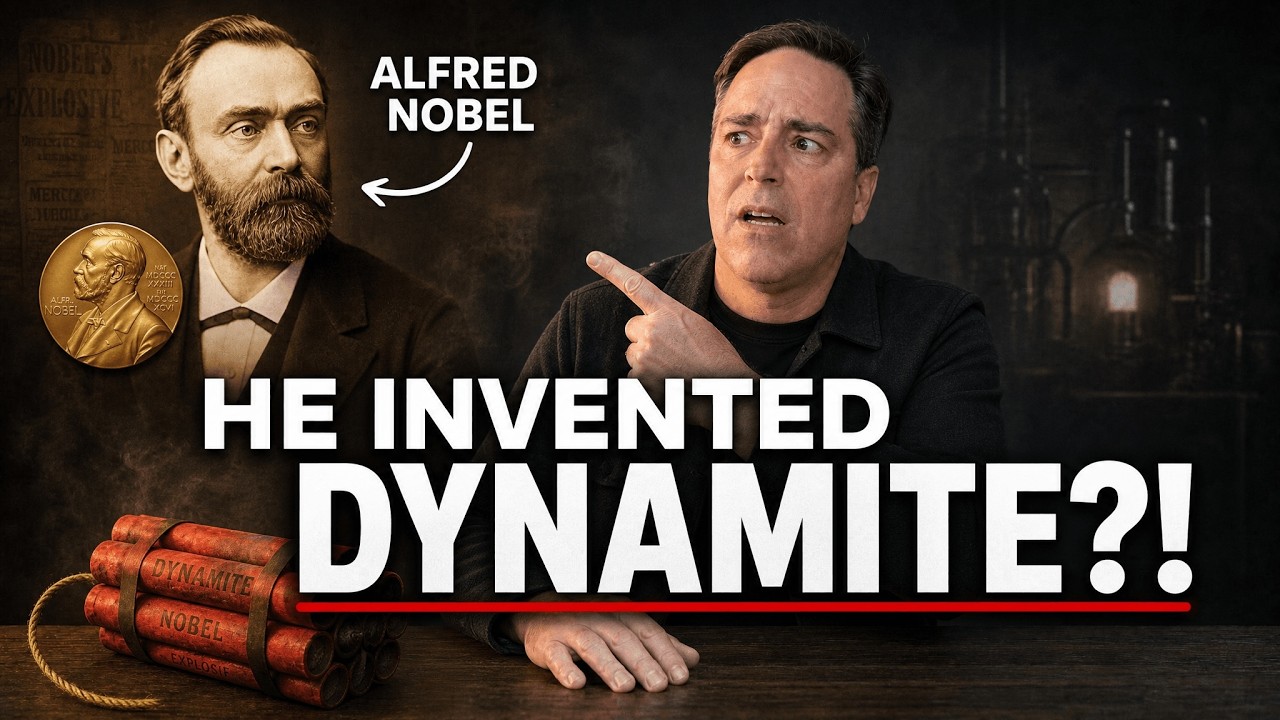
Nitroglycerin wasn't Nobel's invention. An Italian chemist named Ascanio Sobrero first produced it in Turin in 1847, and he spent a good portion of the rest of his life trying to talk people out of using it. An explosion in his laboratory had left his face scarred.
"When I think of all the victims killed during nitroglycerine explosions, and the terrible havoc that has been wreaked," Sobrero wrote, "I am almost ashamed to admit to be its discoverer."
Nobel ran into the compound in Paris, in the laboratory of Théophile-Jules Pelouze, where Sobrero had studied a few years earlier. Sobrero's judgment was that the stuff was too dangerous to sell. Nobel's judgment was that it was too valuable not to.
Detonate: The Part That Made Him Rich
The early years proved Sobrero's point. In September 1864, an explosion at the family's nitroglycerin operation at Heleneborg in Stockholm killed several workers, including Alfred's youngest brother, Emil. The city responded by banning nitroglycerin manufacture inside Stockholm's limits, so Nobel moved the work onto a barge on Lake Mälaren and carried on.
The fix he eventually landed on was almost boring. Soak liquid nitroglycerin into kieselguhr — a soft, porous earth made of fossilised diatoms — and you get a paste you can shape into sticks, ship, drop, and detonate on purpose with a blasting cap. He patented it in 1867 and called it dynamite.
By the time he died he held 355 patents and had built roughly 90 factories across more than 20 countries. Amanda's read on him was that inventors mostly want to invent and don't always follow the consequences; Pete's was that a man who earned hundreds of millions selling explosives knew exactly what he was selling. The episode doesn't settle it, and neither does this post.
Dilate: The Part a London Doctor Found
The medical half of the story started as an occupational complaint. Workers handling nitroglycerin got violent headaches, which faded over the weekend and came roaring back on Monday. Munitions plants called it Monday disease. It was vasodilation — their blood vessels were opening up, and nobody yet knew why.
In 1879, an English physician named William Murrell published a paper in The Lancet titled "Nitro-glycerine as a remedy for angina pectoris." Chest pain from a heart starved of blood, treated by the same substance blasting tunnels through the Alps. The idea was strange enough that pharmacists sold it under the name trinitrin, which is the naming trick Nobel himself remarked on in that letter to Sohlman — not to scare the chemist and the public.
Nearly 150 years later, nitroglycerin is still a standard treatment for angina. Murrell's version and the modern version are recognisably the same drug.
The Patient Who Refused It
When Nobel's doctors first recommended nitroglycerin for his heart in 1890, he turned it down. He'd spent three decades handling the compound industrially, and he had a fairly clear idea of what it did.
He gave in eventually. The Sohlman letter is from October 1896. He'd signed his final will in Paris on 27 November 1895, leaving the bulk of his fortune to the prizes. He died of a stroke in San Remo on 10 December 1896 — the date every Nobel ceremony has been held on since.
It Took Another Nobel Prize to Explain the First One
Pete didn't have this part in his notes, and neither did anyone else for a long time. Nobody actually knew why nitroglycerin worked on hearts until the 1970s. Murrell had a treatment with no mechanism behind it for almost a century.
In 1977, Ferid Murad, then at the University of Virginia, worked out that nitrates release nitric oxide, and that nitric oxide relaxes smooth muscle. Robert Furchgott and Louis Ignarro came at the same molecule from other directions, and in 1998 the three of them shared the Nobel Prize in Physiology or Medicine for their discoveries concerning nitric oxide as a signalling molecule in the cardiovascular system.
Count it out. A hundred and two years after Alfred Nobel died taking a drug he didn't trust, the prize he funded with his will went to the people who finally explained how that drug worked. The nitric oxide pathway they mapped is also the one that later produced sildenafil, so the molecule has now been repurposed twice by people who weren't looking for it.
The Molecule Doesn't Have an Opinion
Nitroglycerin doesn't know whether it's in a mine shaft or under somebody's tongue. It has one behaviour, and the behaviour has no moral position. Everything else in this story — the fortune, the guilt, the brother, the will, the medal — was added by people deciding what to do with a fast reaction.
Which is roughly what Episode 116 ends up arguing about the prizes themselves. Six categories, decided by five institutions, handed out once a year to announce what humanity thinks is worth rewarding. The chemistry didn't change across any of it. Everything that did change was us.
Episode 116 of Sorta Sophisticated is the full strange machine behind the Nobel Prizes, with Amanda asking the questions Pete didn't prepare for. Also in there: why the Peace Prize alone is handed out in Norway instead of Sweden and why historians still can't agree on the reason, plus the British lord who beat Gandhi to the prize in 1937.
Hear the full episode here 👇 The Strange Story Behind The Nobel Prize (Episode 116)
Or watch it on YouTube 👀 Alfred Nobel's Nobel Prize Secret: Dynamite, Peace & Controversy (Episode 116)
