
What Is the Twilight Zone in the Ocean? The Middle Child That Keeps Your Sushi on the Menu
Yellowfin tuna spend about 3% of their time in a part of the ocean most people have never heard of, yet roughly half the carbon in their bodies comes from food they find there. So what is the twilight zone in the ocean? It's the dim middle layer of the open sea, from about 650 to 3,300 feet (200 to 1,000 meters) down. That puts it below the sunlit surface and above the pitch-black deep. Scientists call it the mesopelagic zone. The nickname is real, and Pete made Amanda hum the TV theme every time he said it.
What Is the Twilight Zone in the Ocean, Exactly?
The ocean's twilight zone, or mesopelagic zone, is the layer of open ocean from roughly 200 to 1,000 meters (about 650 to 3,300 feet) deep, where a little sunlight still reaches but not enough for plants to photosynthesize.
Oceanographers split the water column into layers, and Pete's comparison on the episode was a layer cake. On top is the sunlit zone, which runs from the surface to about 650 feet and holds the whales, dolphins, and sharks most people picture. Below 3,300 feet is the midnight zone, where no sunlight reaches at all. The twilight zone sits in the middle, and it runs through every ocean on the planet.
The Middle Child of the Ocean
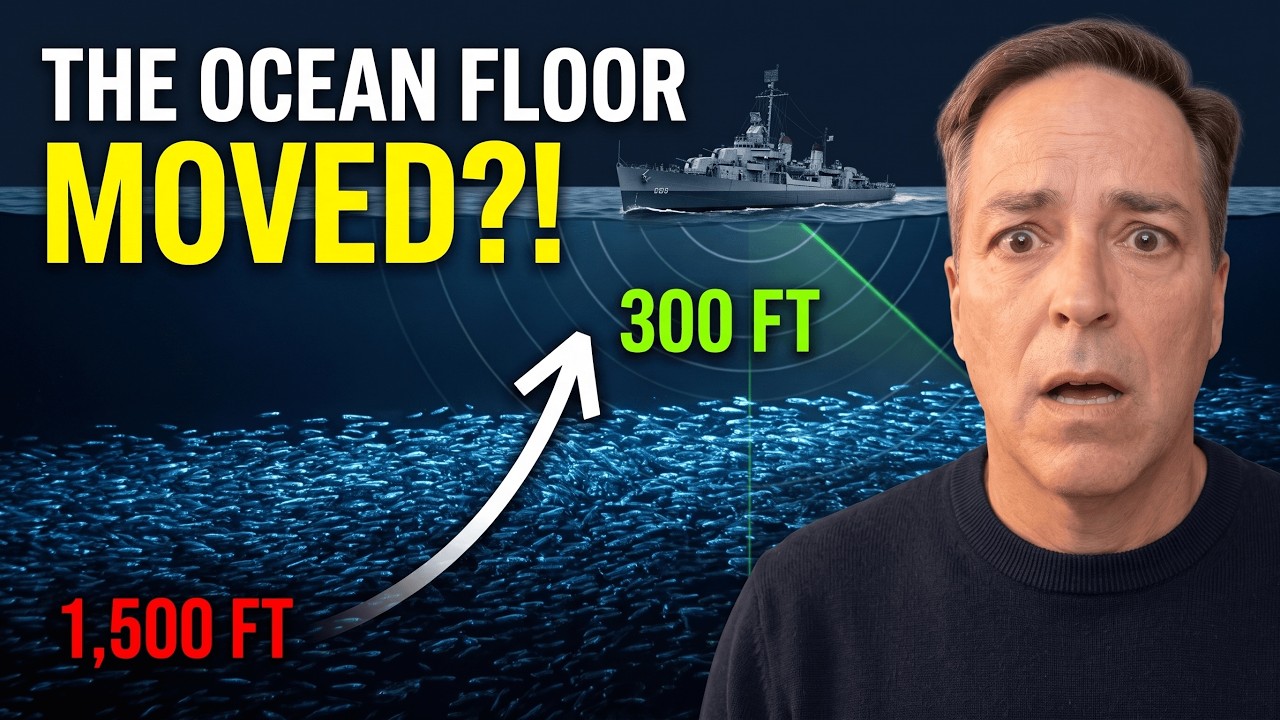
Amanda called it "the middle child" of the ocean, and Pete, one of two middle children himself, ran with it. It fits. For a long time scientists assumed the middle of the ocean was close to empty. They figured it was too dark, too cold, and under too much pressure for much to live there, and that assumption lasted until Navy sonar picked up a false seafloor in 1942.
The darkness comes on in stages. Water absorbs red light first, and it's mostly gone within the first 30 feet or so. Pete's brother Dave, a lobster diver, says that's why his own blood looks green when he cuts himself underwater. Orange, yellow, and green fade out next. By the top of the twilight zone only a dim blue is left, and by the bottom of it that's gone too.
The pressure climbs the whole way down. Every 33 feet of seawater adds one atmosphere, about 14.7 pounds per square inch, so the bottom of the twilight zone sits at roughly 100 times the pressure at the surface, close to 1,470 pounds on every square inch. Pete's way of picturing it was a cow sitting on each nipple and another one on your nose.
Hiding With the Lights On
What lives down there mostly makes its own light. In 2017, Séverine Martini and Steve Haddock of the Monterey Bay Aquarium Research Institute went through video from 240 robotic dives in Monterey Bay, counted more than 350,000 animals, and found that about three quarters of them could produce light. That figure covers everything from the surface to about 4,000 meters, not only the twilight zone, but it shows how ordinary glowing is in the open ocean.
Twilight zone animals use that light in a few ways. Some flash it as a burglar alarm when something grabs them, which can draw in a bigger predator to go after the attacker. Some use it to hunt. The trick Pete found most fascinating on the episode is called counter-illumination: an animal lights up its belly to match the faint light coming down from above, so a predator looking up from below can't see its silhouette.
The zone also holds what is believed to be the most abundant vertebrate on Earth, which isn't people or chickens. It's the bristlemouth, a small fish about the length of your finger. Estimates put their numbers in the hundreds of trillions, and possibly higher.
They Take Out the Trash
When Amanda asked what any of this does for humans, Pete's answer was "They take out all our trash." Every night, huge numbers of twilight zone animals swim up to eat near the surface and then go back down before sunrise. That daily trip is often described as the largest animal migration on Earth. The animals digest their food and excrete it at depth, and when they die, many of their bodies sink. Both carry carbon from the surface down into the deep ocean, part of a process called the biological carbon pump. Without it, more of that carbon would stay near the surface, where it can return to the air.
They also feed the fish we eat, which is where the sushi comes in. Ciara Willis, working with Woods Hole Oceanographic Institution, analyzed liver tissue from tuna and swordfish caught off the US Northeast. Yellowfin tuna spend about 3% of their time in the twilight zone and get about half their carbon from prey that lives there. Bigeye tuna spend about 16% of their time there and get about 67%. Pete put it as "we wouldn't be eating sushi" without it, and the numbers mostly back him up.
Nobody's Watching the Middle Child
Willis estimates the twilight zone holds about 10 billion tons of fish, not counting squid and shrimp. That much protein has drawn commercial interest, mostly from industries that turn small fish into fishmeal and fish oil for fish farms. Pete's complaint on the episode was that this is happening before anyone fully understands the zone. He compared it to the Wild West before Wyatt Earp showed up in Tombstone. Much of the twilight zone lies in international waters, where rules are harder to set and harder to enforce.
The episode's closing point is that people tend to treat what they can see as what matters. The Navy looked at the twilight zone and saw a floor. Scientists looked at it and saw a desert. It turned out to be one of the busiest parts of the planet, and almost everything it does happens in the dark.
---
This is the main topic of Episode 126 of Sorta Sophisticated, "The Largest Migration You've Never Heard Of - 100 Fathoms Down." Listen for the glowing fake jellyfish that lured in the first footage of a live giant squid in its own habitat, and the Japanese bay where millions of firefly squid light up the water every spring.
Hear the full episode here 👇 The Largest Migration You've Never Heard Of - 100 Fathoms Down (Episode 126)
