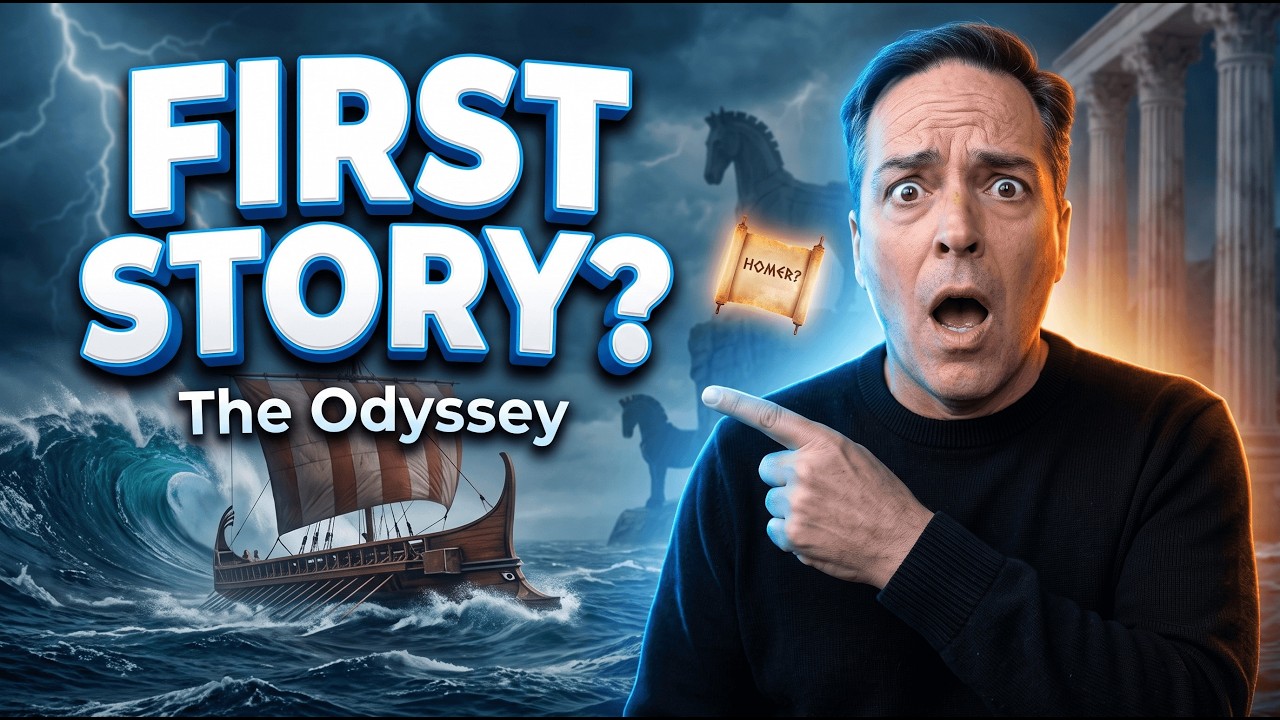
What Is the Homeric Question? The 2,700-Year-Old Argument Over Whether Homer Was Ever a Real Person
There is no birth record, no grave, and not one word written about Homer by anybody who lived at the same time as him. Pete drops that on Amanda about eight minutes into Episode 111 of Sorta Sophisticated and she stops the show cold: "I'm sorry, what?" So what is the Homeric Question? It's the long-running scholarly argument over who actually composed the Iliad and the Odyssey — one poet named Homer, or generations of anonymous singers whose work got collected under a name that may never have belonged to a person at all.
What Is the Homeric Question, Exactly?
The Homeric Question is the debate over the authorship, composition, and historical existence of Homer, specifically whether the Iliad and the Odyssey were written by a single poet, assembled from centuries of oral performance by many poets, or some combination of the two.
It's called a question rather than a controversy because it never resolved. It was open in antiquity and it's open now.
What We Actually Have on Homer: Nothing
There is no contemporary document naming Homer. No inscription, no tomb, no letter, no record of a payment. Seven different Greek cities claimed to be his birthplace, which is roughly the historical equivalent of seven towns claiming the same celebrity and none of them producing a receipt.
The ancient Greeks didn't know either. Herodotus, writing in the fifth century BC, guessed that Homer lived "not more than four hundred years" before his own time, which puts him somewhere around 850 BC. That estimate came from a man who was already 400 years too late to check. The tradition that Homer was blind traces largely to one line in the Homeric Hymn to Apollo, where the narrator describes himself as a blind man living on the rocky island of Chios. That's a poem describing its own speaker. It became a biography by repetition.
Pete's summary on the show is blunt and, on the evidence, correct: "There is absolutely no evidence that a man named Homer ever existed. No birth record, no grave. No writings about him from any time in his lifetime, after his lifetime."
The Two Camps Have Names, and They've Been Fighting Since 1795
The modern version of the fight starts with a German scholar named Friedrich August Wolf, who published Prolegomena ad Homerum in 1795. Wolf's argument was mechanical rather than aesthetic: Greece in the eighth century BC had barely adopted writing, and a poem of 12,000 lines could not have been composed in a medium that didn't functionally exist yet. So the epics had to be oral, and if they were oral, they were the work of many mouths over many years, stitched together later.
That book split classicists into two camps that still have names.
The Analysts hold that the poems are composites: layers of older material from different poets and different centuries, assembled and edited into the versions we have. The Unitarians hold that the design is too tight for a committee. The Odyssey's three storylines braid and converge, its foreshadowing pays off hundreds of lines later, and its ending answers its opening. Somebody, they argue, shaped it.
Pete lays out both sides on-mic without picking a winner, which is the honest treatment: either "it was just a name that got made up, attached to the story," or "there was actually one exceptionally talented poet... who pulled all these stories together." And he adds the detail most summaries leave off. If there was one poet, we have no idea what that person's name was, or whether it was a man.
The Guy Who Cracked It Went Looking for Living Bards
The most useful thing anyone ever did with the Homeric Question was refuse to argue about it.
Milman Parry, an American classicist, noticed in his 1928 doctoral work in Paris that Homer's language is built out of repeated, ready-made phrases: the wine-dark sea, rosy-fingered dawn, much-enduring Odysseus. Those aren't decorations. Each one fills a specific metrical slot in the line, and a performer who has hundreds of them memorized can compose in meter at speaking speed without a script.
Parry then did something unusual for a classicist. He went to find someone still doing it. In 1933 he traveled to Yugoslavia with his student Albert Lord and recorded illiterate village singers, the guslari, performing epics thousands of lines long, improvising within the tradition, producing a different version every time and insisting each time that they'd sung it exactly as they always had. Parry died in 1935 at 33. Lord published the findings in The Singer of Tales in 1960.
What that fieldwork established is that the question was badly posed. "Did one person write it or did many?" assumes writing. Oral composition doesn't work that way. A singer is composing and performing simultaneously, inside a tradition built by everyone who sang before him, and the result belongs to a person and a lineage at the same time.
Homer Might Have Been the First Podcaster
Amanda's reframe in the closing recap is the best thing in the episode, and it holds up past the joke.
Before the poems were written down, professional performers carried them from town to town, reciting from memory at festivals and banquets, doing character voices, holding a room for hours. Pete's comparison is Hamilton without the sheet music. The later performers of a fixed text were called rhapsodes; the earlier singer-composers, the ones improvising with a lyre, were the aoidoi.
The part that matters is what the road did to the material. Every one of those performances was a test. A section that bored the room got cut. A line that landed stayed. Over centuries, the material got edited by thousands of live audiences, which is the closest thing the ancient world had to analytics.
So when the text finally got fixed in writing, probably around 700 BC (the division into 24 books likely came much later, from scholars in Alexandria), what got written down wasn't a first draft. As Amanda puts it, it's arguably "the most crowd-tested piece of literature in all of history." Nobody had a script, nobody had an editor, and the feedback arrived in the room, for a few hundred years running.
A Myth About a Myth
Amanda's other line is the one that sticks: "It is quite literally a myth about a myth."
We tell a story about a blind poet in ancient Greece who single-handedly invented Western literature, and that story has almost exactly as much documentary evidence behind it as the story about the one-eyed giant. We invented an author because a poem this good felt like it needed one. The instinct to attach a name to a thing we love is apparently 2,700 years old.
What survived the argument is the poem. Whoever they were, one poet or forty or a tradition with no owner, they made something people have refused to stop retelling for 27 centuries, and the name we use for them is a placeholder we agreed on later.
Episode 111 of Sorta Sophisticated is the full crash course on the Odyssey, timed to Christopher Nolan's adaptation with Matt Damon, shot entirely with IMAX film cameras on a $250 million budget. Also in there: why the poem starts seven years into a shipwreck instead of at the beginning, and the short scene about an old dog on a dung heap that Pete says still makes everybody cry.
Hear the full episode here 👇 The Story That Invented All Stories (Episode 111)
