What Is the Bortle Scale? The UV Index for Darkness, and Why Your Backyard Is Probably a 9
By Pete's own estimate, the sky over the Sorta Sophisticated studio rates a nine, the worst score on a scale that only goes to nine. He's talking about the Bortle scale, which also explains why the Milky Way shows up in photos but never over your driveway. The short answer to what is the Bortle scale: a nine-level rating of how dark the night sky is at a particular spot. Class 1 is the darkest sky left on Earth, and class 9 is an inner-city sky. You rate a place by what you can actually see with your own eyes.
What Is the Bortle Scale, Exactly?
The Bortle scale is a nine-point rating of night-sky darkness, from class 1 (an excellent dark-sky site) to class 9 (an inner-city sky), based on which stars and sky features are visible to the naked eye from a given location.
Pete gets the history right on-mic: "John Bortle published in 2001." Specifically, amateur astronomer John E. Bortle introduced it in the February 2001 issue of Sky & Telescope. Light pollution had gotten bad enough that many amateur astronomers had never seen a truly dark sky, so they had no way to know what they were missing. Bortle had the experience to describe it. He wrote Sky & Telescope's "Comet Digest" column from 1977 to 1994 and logged more than 200,000 variable-star observations for the AAVSO. There's an asteroid named after him, 4673 Bortle.
The Bortle scale is also informal in one specific way. It's a descriptive checklist that you judge by eye, not a reading from an instrument, and two people with different eyesight can rate the same field differently. When astronomers want a hard number, they use a Sky Quality Meter, which measures sky brightness in magnitudes per square arcsecond. Light-pollution maps often convert those readings back into Bortle classes because the 1-to-9 version is easier to picture.
A UV Index, but for the Dark
Pete's way into it is the comparison that makes it click: "Like we have the UV index." The UV index tells you how much sun you're getting. The Bortle scale tells you how much night you're getting.
Bortle measures that with benchmarks, and the Milky Way is the one most people care about. Here's roughly how it changes as you move up the scale:
- Class 1: the naked eye reaches stars around magnitude 7.6 to 8.0, and the Milky Way's Scorpius and Sagittarius region is bright enough to cast shadows. - Class 2: the summer Milky Way looks highly structured to the naked eye. - Class 3 (rural): the Milky Way still looks complex. - Class 5 (suburban): it's washed out overhead and invisible near the horizon. - Class 7: it's nearly or totally gone. - Class 9 (inner city): the faintest stars you can see are around magnitude 4.0 or brighter, and the Milky Way is out of the question.
The starlight is the same everywhere. What changes is how much glow from the ground washes it out.
Night Five Doesn't Work From a Nine
The scale matters to Pete's own homework. Later in the episode he gives listeners a five-night plan. Night one is finding the Big Dipper and following it to Polaris. Night two is spotting planets by whether they twinkle. Night three is the moon through binoculars ("binoculars better than telescope for the novice"). Night four is Orion in winter or the Summer Triangle in summer. Night five is the Milky Way band.
The first four nights hold up reasonably well under city lights, since bright stars, planets and the moon cut through the glow. Night five doesn't. By Bortle's own descriptions, you need something like a class 4 sky before the Milky Way looks impressive, and the hosts' home sky is five classes past that.
Amanda sees it coming ("I'm gonna find it in the city"), and Pete's fix is the right one: "You just gotta get outta the city, drive like an hour." Moving a few classes down the scale does more for the Milky Way than buying gear. Amanda adds a tip that keeps you from wasting the drive. Put your phone in red mode, because red light doesn't wreck the dark adaptation your eyes spend a long time building.
Joshua Tree Is Closer to a Two Than a One
Amanda knows the Bortle scale from the other direction, through dark-sky parks: "In the US there's like the Dark Skies program. Like Joshua Tree is one of them." The organization is DarkSky International, and Joshua Tree National Park received its International Dark Sky Park designation in 2017.
Pete puts Joshua Tree at "like a one or a two." Light-pollution maps put most of the park around class 3, with pockets of class 2 in the eastern backcountry. The western horizon picks up glow from the Coachella Valley and, beyond that, the Los Angeles basin. So it isn't a one, but going from a nine to a two or three is enough to change what you see.
The Sky Didn't Get Dimmer, We Got Brighter
What stands out about the Bortle scale is that it had to be written at all. For almost all of human history, class 1 and 2 skies were just what night looked like. Bortle wrote the scale in 2001 because a lot of people who loved the sky had never seen it that way.
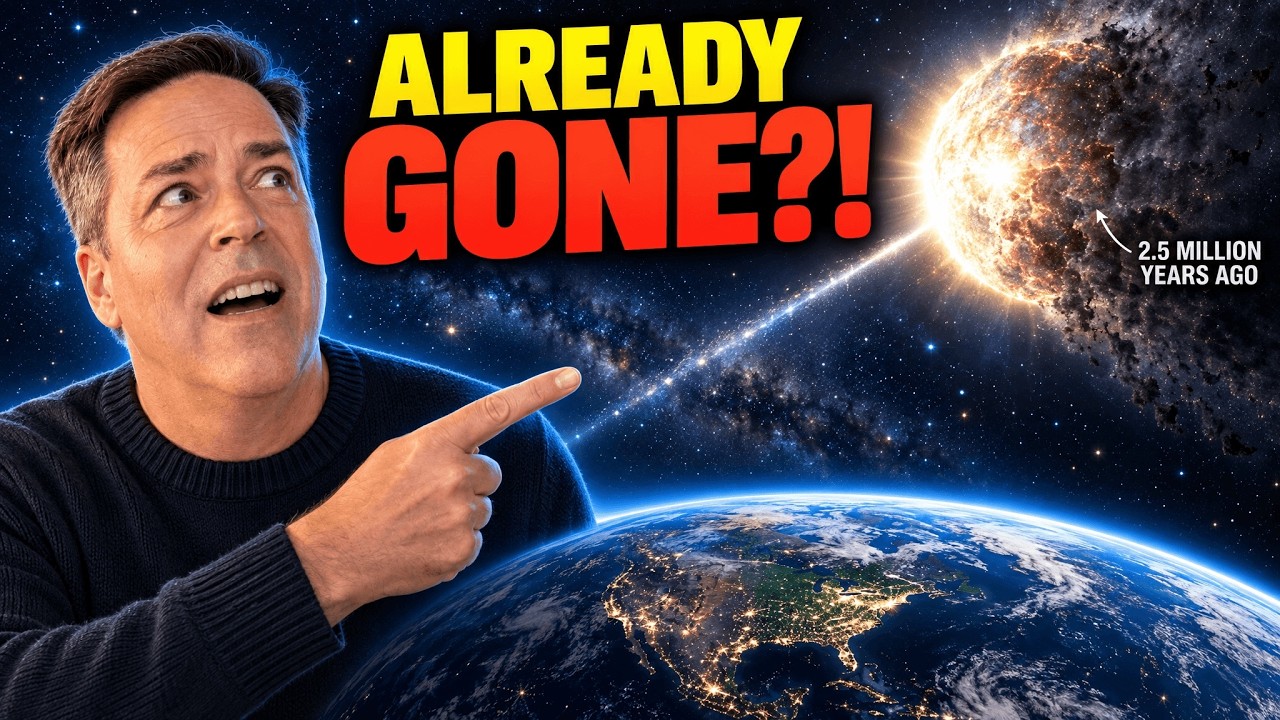
That's the idea behind the whole episode. Pete's pitch is that looking up means looking back in time, at light that left Sirius about eight and a half years ago and Andromeda about 2.5 million years ago. All that old light still reaches us, and in a class 9 city we can't see most of it. His sign-off works as a Bortle summary too: "The sky hasn't changed in thousands of years. We just stopped paying attention to it."
---
Episode 120 of Sorta Sophisticated, "Everything You See Tonight Already Happened," is Pete's week-old stargazing obsession played out on-mic. It covers why Betelgeuse might already have exploded without us knowing, and why Venus is hotter than Mercury even though Mercury sits closer to the sun. It also has the reason no one has ever photographed the Milky Way from outside, which means every picture of our galaxy you've seen is a reconstruction.
Hear the full episode here 👇 Everything You See Tonight Already Happened (Episode 120)
