What Is the Birthday Paradox? Twenty-Three Strangers and a Coin Flip You'd Lose
Every squad at the 2014 World Cup had exactly 23 players on it. Sixteen of the thirty-two squads contained two men who shared a birthday — half the tournament, which is almost precisely what the math predicts. So what is the birthday paradox? It's the finding that in a randomly assembled group of just 23 people, there's a slightly better than even chance that two of them share a birthday. Not the same star sign. The same date.
When Pete brought this up on Episode 113, Amanda's response was two words long: "No way." Then, "23?" That reaction is the reason the thing has "paradox" in its name.
What Is the Birthday Paradox, Exactly?
The birthday paradox is the mathematical fact that a random group of 23 people has a 50.7% chance of containing at least one pair with the same birthday, and the odds climb faster from there than almost anyone guesses.
Thirty people gets you to 70.6%. Fifty gets you to 97%. At 70 people it's 99.9% — a near-certainty in a group smaller than most wedding receptions.
The technical name for this kind of result is a veridical paradox: nothing about it is self-contradictory, it just feels wrong. The math is ordinary. Your intuition is the part that's broken.
Nobody is entirely sure who noticed it first. It's usually traced to the mathematician Harold Davenport around 1927, though Davenport never published it and declined to claim credit, on the grounds that he couldn't believe nobody had thought of it before him. The first version in print came from Richard von Mises in 1939.
You're Counting People. The Math Is Counting Pairs.
The gut goes wrong in a specific, universal way, and it has nothing to do with being bad at math.
You picture yourself standing in the room, scanning 22 other faces for your own birthday. That version really is unlikely, about a 6% shot. If you want a coin-flip chance that somebody in the room matches your specific date, you need 253 people.
But that isn't the question. The question is whether any two people match, and you are not the center of it. Twenty-three people can be arranged into 253 different pairs, and every single pair is its own roll of the dice. You're not running 22 chances. You're running 253.
That the number 253 shows up in both calculations is a coincidence, and a genuinely funny one given the subject.
The formula works by going backwards. Line people up and ask what the odds are that they all miss each other: the second person has 364 free days out of 365, the third has 363, the fourth 362. Multiply that chain out and by the 23rd person it has fallen just under 50%. Whatever's left over is the chance of a match.
Sixteen of the Thirty-Two
The World Cup is the best real-world test of this that exists, because FIFA hands you the sample: 32 national squads, 23 players each, names and birth dates published.
In 2014, 16 of the 32 squads had at least one shared birthday. Five of them (Argentina, France, Iran, South Korea and Switzerland) had two separate pairs apiece. Exactly half the tournament, from a prediction of 50.7%.
Real birthdays aren't spread evenly across the calendar either, which people sometimes raise as an objection. It cuts the other way. Clustering makes collisions more likely, not less, so 50.7% is the floor.
Amanda Had Never Heard of It, Which Is the Whole Argument
The episode gets to the birthday paradox at the end of a long stretch about why humans are bad at probability, and Pete calls it "literally one of the best examples of how bad our brains are at putting together probabilities."
His theory of why is decent. Our probability instincts were built for a world of causes and consequences, not independent random events. Eat those berries and people die, so stop eating the berries. Joey wandered off and got eaten by a saber-toothed cat, so don't wander off. That machinery is superb at pattern-matching and hopeless at combinatorics, and we're still running it. As Pete put it, we're on old software.
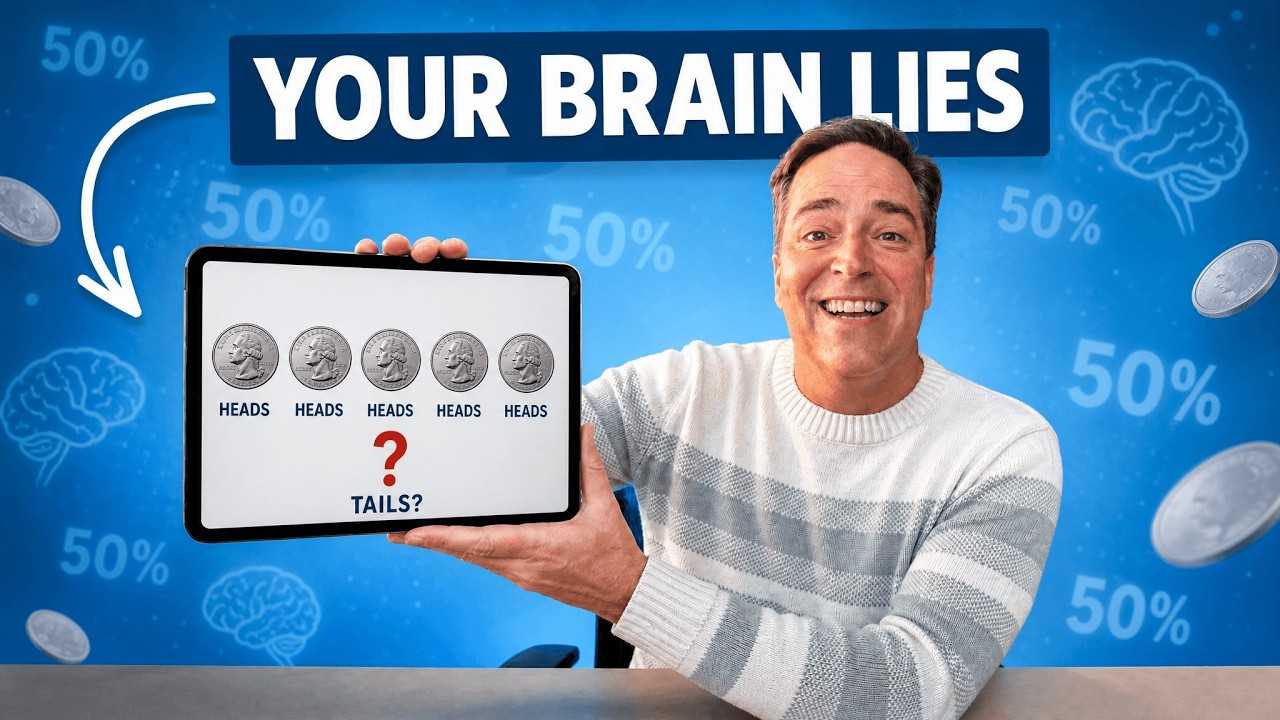
It's the same equipment that makes ten heads in a row feel like tails is owed. It isn't. The coin doesn't remember anything, and 23 people is more of a crowd than it looks.
Hackers Break Things With This on Purpose
The paradox has a job outside of party tricks. In cryptography it's the basis of the birthday attack.
If you're trying to force two different files to produce the same hash, you don't have to grind through every possible output. You only have to generate enough candidates for two of them to collide with each other, which happens around the square root of the number of possibilities. That's the 253-pairs trick applied to hash functions, and it's why a hash long enough to look safe on paper can be attacked with far less work than the raw number suggests.
The same arithmetic that decides whether two midfielders blow out their candles on the same day sets the key length on the encryption protecting your bank.
Coincidence Is Mostly a Counting Error
The birthday paradox is doing the same work as everything else in that episode. You think of an old friend and they text you that afternoon. You meet somebody at a party who grew up two streets over. Both feel like signals, and both are what happens when you count every possible pairing instead of only the one with you at the center.
There are hundreds of people who could text you on any given day, and thousands of days for it to happen on. Something in that grid is going to line up. It always does. That's not the universe leaning in, it's 253 pairs doing what 253 pairs do.
Which is oddly freeing. If coincidence is mostly a counting error, then luck is mostly a counting exercise. Put yourself in more rooms and more of the improbable stuff starts happening to you specifically.
Episode 113 of Sorta Sophisticated makes the case that lucky people aren't smarter, they just notice more. Also in there: the psychologist who hid £250 in a newspaper and watched half his volunteers turn the page on it, and the word of the week Amanda immediately weaponizes against Pete mid-argument.
Hear the full episode here 👇 Lucky People Aren't Smarter: They Just Notice More (Episode 113)
