What Is Terribilità? The Art-History Word for Why Michelangelo's Bodies Look Like That
Amanda went to art school, where she says the David is the one you stand there and stare at, and she still had to stop Pete halfway through Episode 118 to ask whether there was a name for the way Michelangelo painted people. There is. Pete had it, mangled the pronunciation on-mic, and told everyone to memorize it anyway. So what is terribilità? It's the term art historians use for the overwhelming, faintly frightening power in Michelangelo's work: huge bodies under visible strain, anatomy pushed past what a real body actually does. Pete's pitch is that once you have the word you start seeing it everywhere, and he's right.
What Is Terribilità, Exactly?
Terribilità is the quality in Michelangelo's art that produces awe bordering on fear: figures of enormous physical force and tension that overwhelm the viewer rather than charm them.
The root is the Italian terribile, and the older sense of "terrible" is the one that matters. Not bad, but frightening the way weather is frightening. The kind of thing you look up at.
One honest caveat, because it's the sort of thing this show would rather say out loud: terribilità is a critical label, not a technique. Michelangelo never announced he was doing it. It's a word other people reached for because his work kept doing something to them that the existing vocabulary couldn't cover.
It Started as a Complaint About His Personality
Here's the part that makes the word worth knowing. Before anybody applied terribile to the art, they were applying it to the man, and they did not mean it as a compliment.
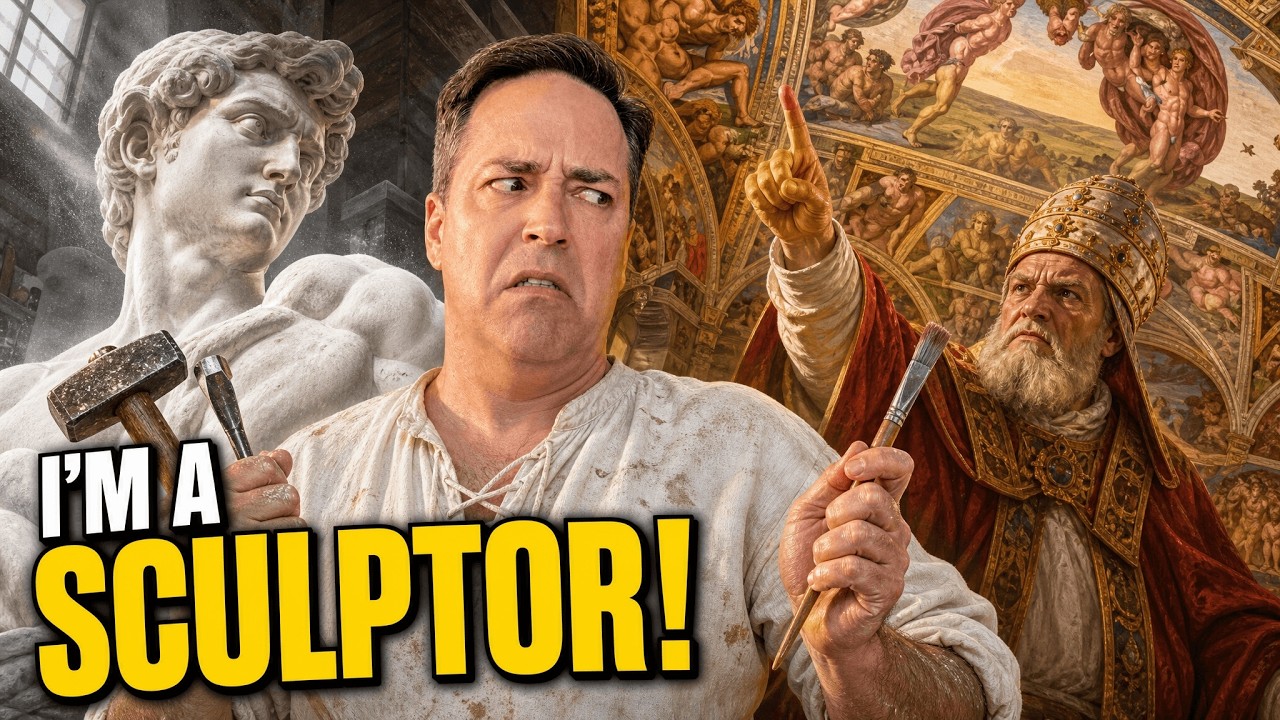
Pope Julius II — the same pope who bullied him into painting the Sistine ceiling — reportedly described Michelangelo as a uomo terribile, a terror of a man. Which, given that the two of them fought for four straight years and Michelangelo walked off the job more than once, sounds less like art criticism and more like an HR complaint.
The clearest surviving trace is a letter the painter Sebastiano del Piombo sent Michelangelo on October 15, 1520, reporting what Pope Leo X had just said about him: he is terribile, as you see; one cannot deal with him. Del Piombo wrote again the following month and quietly moved the word where it's lived ever since. Michelangelo, he argued, was terrible only in his art.
Then Giorgio Vasari made it permanent. In his Lives of the Most Excellent Painters, Sculptors, and Architects (1550, revised 1568), Vasari built the term into a full art-historical category and set it opposite Raphael's grazia, grace. Raphael made you comfortable, Michelangelo made you flinch, and Vasari thought flinching was the higher achievement.
So a word that started out meaning "impossible to work with" ended up as the highest praise available in the Renaissance, and nobody moved it there on purpose.
The Sculptor's Cheat Code Was Cadavers
Pete's argument in the episode is that Michelangelo's painted bodies landed differently because he wasn't a painter at all. He was a sculptor being forced to paint, and he brought a sculptor's knowledge of the human form up onto a ceiling. That's the right read, and there's a specific, slightly grim reason it worked.
Starting around 1492, as a teenager, Michelangelo was given access to the corpses at the hospital of Santo Spirito in Florence. He dissected them. He spent roughly three years learning where the tendons attached and how the muscle sat over the bone, and by tradition he thanked the prior, Niccolò Bichiellini, with a carved wooden crucifix.
That's where terribilità comes from. Everyone else was painting the outside of a person. He was painting a body he had taken apart with his hands, then loading it with more torque than a body could survive. The ceiling took from 1508 to 1512, and by the time he came down he had put more than 300 figures and nine scenes from Genesis over a room that was supposed to get twelve apostles.
He also hated it the entire time. He wrote letters home about wanting to die and a genuinely funny, genuinely miserable poem to his friend Giovanni da Pistoia that opens, in Gail Mazur's translation, I've already grown a goiter from this torture.
Where to Actually Look for It
The reason Pete calls this a dinner-party cheat code is that terribilità is repeatable. Learn it once and it works on everything the man ever made.
Look at the Creation of Adam and skip the famous fingers. Look at Adam's torso instead — the ribcage, the thigh, the whole body screwed into a pose nobody actually holds. Look at the ignudi, the twenty nude young men wedged around the edges of the ceiling doing nothing in particular with tremendous effort. Look at the Moses carved for Julius II's tomb, sitting there with his forearms corded like he's about to stand up and end the conversation.
Then look at the Last Judgment, the altar wall he came back and painted between 1536 and 1541. Clement VII commissioned it, Paul III pushed it through, and it has recently been back under the restorers' lamps, which is roughly how this episode got started. It's the same vocabulary turned dark: hundreds of bodies rising, falling, being hauled downward, every one of them straining.
The David gets the tourists, but it's worth knowing his proportions are deliberate too. That block of marble was commissioned in 1464 for the roofline of Florence's cathedral, well over two hundred feet up. The oversized head and hands were sized for a viewer standing on the ground looking almost straight up. We put him at eye level instead, and now he looks like a man with big hands.
The Difficulty Is Visible in the Work
What's strange about terribilità is that it names something we usually try to hide. Most craft is about making the effort disappear: the seamless take, the invisible edit.
Michelangelo went the other way. The strain is the subject. His figures look like they're carrying something, and the man carving them was furious, ill, underslept, fighting a pope, and writing poetry about his own neck. Vasari's word caught all of that and made it a virtue: the difficulty stayed in the room.
It's a decent thing to sit with the next time you're stuck doing work you didn't ask for. The four years Michelangelo spent angry on a scaffold produced the most recognizable painting on Earth. He never stopped insisting it wasn't his job.
Episode 118 of Sorta Sophisticated is the Michelangelo the textbooks skip: the sculptor who got drafted into painting and never forgave the man who drafted him. Also in there: why he only ever signed one sculpture, and the small matter of his corpse being smuggled out of Rome disguised as cargo.
Hear the full episode here 👇 The Pope Forced Him to Paint: He Never Forgave Him (Episode 118)
