What Is Living Memory? The 80-Year Window That's Closing on 9/11
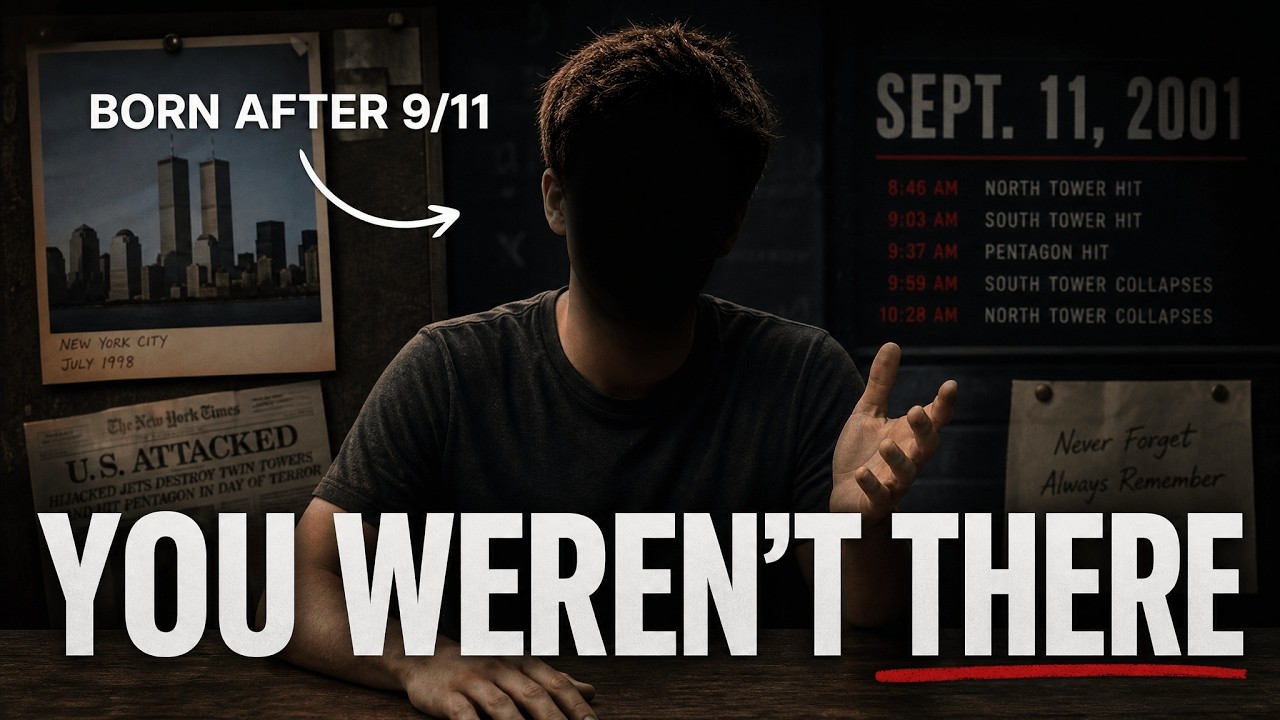
Pete's son Luke wasn't born yet. His daughter Emma was two, which he figures means she doesn't remember any of it. That conversation — the one where the morning you watched live turns out to be somebody else's chapter in a textbook — is where Episode 119 of Sorta Sophisticated starts, and it becomes an hour on what is living memory and when an event stops being one. Living memory is the stretch of time an event stays inside somebody's firsthand recollection, held by people who were actually there, before it hands off to books and museums. 9/11 is crossing that line right now.
What Is Living Memory, Exactly?
Living memory is the period during which an event is still remembered firsthand by people who experienced it — roughly the lifespan of the generations who were there, after which the event survives only through records, photographs and whoever bothers to retell it.
That's the plain version, and it's close to what memory scholars actually measure. The German Egyptologist Jan Assmann split how societies hold the past into two categories. Communicative memory is the everyday, unofficial kind — the stories your grandfather told at the table, unrehearsed and uninstitutionalized. Cultural memory is the formalized kind, kept by specialists and monuments and curricula, and it can run three thousand years.
Assmann's number for communicative memory: about 80 to 100 years, three to four interacting generations. After that, if nobody wrote it down or built something, it's gone.
Pete arrives at nearly the same place from the other direction, working backwards from Pearl Harbor and JFK without a citation in sight. His version is a headcount, not a date. "All you really need to shift is, like, sort of that majority has to start shifting," he says. "It's just gotta be over 50%."
The Handoff Is a Headcount, Not an Anniversary
Amanda floats 25 years as the cusp. Pete doesn't buy it as a cutoff, and he's right not to. "It's not like 25 years, all of a sudden," he says. What moves the needle is attrition — people in their fifties and sixties start passing, the youngest people who genuinely remember age out of the room, and one day more people know the thing secondhand than firsthand.
We're closer to that line than it feels. As of the 25th anniversary, roughly one in three Americans was either born after September 11, 2001, or was too young to have a real memory of it. That isn't a majority yet, but the tally only moves one way.
The anthropologist Jan Vansina, who spent a career on how oral traditions survive, gave the far edge of this a name: the floating gap, the blurry stretch that opens between the recent past people can still speak to and the deep past that's been organized into legend. It doesn't sit at a fixed year. It travels forward as the generations do, always the same distance behind the present. Right now, 9/11 is on the near side of it.
Emotional Texture Is the First Thing to Go
Amanda reaches for the phrase cold, mid-sentence, half-apologizing for it. "It's like a psychology term, like emotional texture, maybe, where it's like, we lose the emotion behind."
Pete more or less falls over. "Why do you know that? You're stealing all of my thoughts." It was the first of three things he'd gone down a research rabbit hole to name.
Emotional texture is the specific, useless human detail. What you were wearing. Who called. What your parents were saying in the kitchen. Pete's texture for that Tuesday is a phone call in a car on the way to work: Gabby on the line, Emma on her hip, pregnant with Luke. Nobody worked that day. Everyone just stood there.
None of that makes it into history, because history has a different job. History keeps 19 hijackers, four planes, three sites, nearly 3,000 dead, 343 FDNY firefighters lost in a single morning. It keeps the numbers because the numbers are what transfer.
Watch it happen in miniature with the Challenger. On January 28, 1986, classrooms all over America were tuned in because a high school teacher, Christa McAuliffe, was going to space — the feel-good story of the decade. Pete was in grade school, and what he remembers is teachers walking out in tears and coming back not knowing what to say. Ask what survives of it now and you get two facts: the teacher died, the O-ring failed. Both true. Neither one is the memory.
One honest note: "emotional texture" isn't a formal construct in memory studies the way communicative memory is. It's a good phrase two people found on-mic for something real. Take it as a label, not a literature.
When the Eyewitnesses Thin Out, the Myths Get Louder
Pete's second symptom is the fun one, and it has receipts: as the people who lived through an event stop being in the room to correct the record, conspiracy theories rush the vacuum. His control group is JFK, and the numbers cooperate.
In the weeks after November 1963, Gallup found 52% of Americans suspected some group beyond the gunman was involved, with 29% saying Lee Harvey Oswald acted alone. The Warren Commission reported in 1964 that Oswald acted alone. By 2023 — sixty years on, most of the eyewitness generation gone — Gallup had 65% believing others were involved. The share who accept the lone-gunman finding is still 29%. It never budged. Everybody who moved, moved toward the conspiracy.
Pete's prediction for 9/11 is that the theories spiked around the ten-year mark, quieted down, and are due back hard in the next 15 to 20 years. Amanda adds the accelerant he didn't account for: an algorithm that rewards the version of an event that gets clicked, not the version that's true. "Whatever they saw in their 10 second reel, that is now truth."
Worth saying plainly, though — the correlation runs in Pete's direction, but nobody has shown eyewitness attrition causes it. Sixty years of movies, hearings and newly released files did plenty of the work too.
The Third Symptom: 100 Units of Weight, Split Four Ways
The last one Pete calls emotional weight, and it's the one he seems least happy about. His model is almost mathematical: "I have 100 units of emotional weight. I just transferred 25 units to each one of my kids." The event doesn't shrink. The weight just spreads across more people, most of whom weren't there, and per person it thins out until it's manageable.
Ask his 19-year-old what 9/11 means, he says, and you'll get something accurate and flat. Planes flew into the World Trade Center. It was really bad. All correct.
Amanda names what's bothering him: "She doesn't have the emotional attachment that you do." And she can't. That's not a failure of parenting or of schools — it's the mechanism. The weight gets distributed to people who didn't earn it, or it dies with the people who did.
Amanda's other worry is bigger than any of the three. "The more Holocaust victims that we lose, the less first person knowledge we have." History doesn't change, she points out — but who's in charge of telling it does, and that's what takes the oomph out.
Photographs Are What the Next Generation Inherits
Here's the part of the episode with a deadline on it.
Right now, a project called Projections is running six nights, September 6 through 11, 2026, gathering more than 30 photographers, photo editors and visual journalists who covered September 11 — from Lower Manhattan to the Pentagon to a field outside Shanksville. Joel Meyerowitz is part of it. So are David Hume Kennerly and Pete Souza. The interviews go out live and get recorded for the public record. The tagline is the whole thesis: Before history was written, it was photographed.
Pete puts a pop quiz to Amanda: name the 9/11 photograph in your head right now. She names the second plane hitting, and people running in the street. He adds the falling man, and firefighters raising the flag in the rubble like a smaller Iwo Jima. Neither of them had to think about it. For everyone who wasn't there, the photographs become the event — which is why Pete's line about the photographers lands: everyone in Amanda's remembered picture is running away from the towers, and the person taking it wasn't.
Amanda's counterweight is the one that should worry you. Photography used to be tactile — you were there, you had a camera, the image was evidence. Now the medium carrying 9/11 into history is the same medium that can be manufactured on a laptop. As she puts it: what happens when we have images that may or may not be true?
The Window Is Still Open, Which Is the Whole Point
The strange thing about the 25th anniversary isn't that 9/11 is becoming history. Everything does. Pearl Harbor did. The Holocaust is doing it now, one funeral at a time.
The strange thing is that the crossing is happening in public, in a country where the people who watched it live and the people who will only ever read about it are still at the same table. Assmann's 80 years put the end of that overlap somewhere around 2081.
Which makes the window an assignment more than a tragedy. Pete's advice at the end of the episode isn't complicated, and it isn't about memorizing casualty figures. "Just fucking care. Watch something. Be intentional about it."
Living memory doesn't run out when people forget. It runs out when there's nobody left in the room to ask.
---
Episode 119 of Sorta Sophisticated, "You Had To Be There: Why 9/11 Just Turned Into History (25 Years Later)," has Pete and Amanda naming their own — the moments they'll be telling their grandkids about, from the afternoon Amanda watched the 2008 market fall off a cliff on a TV in an Italian restaurant to the one Pete swears he never thought he'd live to see. There's also a word of the week hiding in the episode that means "majestic" and is spelled exactly like the month, plus Pete's fun fact that the name "9/11" nearly lost out to the labels the networks tried first.
Hear the full episode here 👇 You Had To Be There: Why 9/11 Just Turned Into History (25 Years Later) (Episode 119)
