
What Is Janteloven? The Unwritten Danish Rule That Explains Why Copenhagen Works
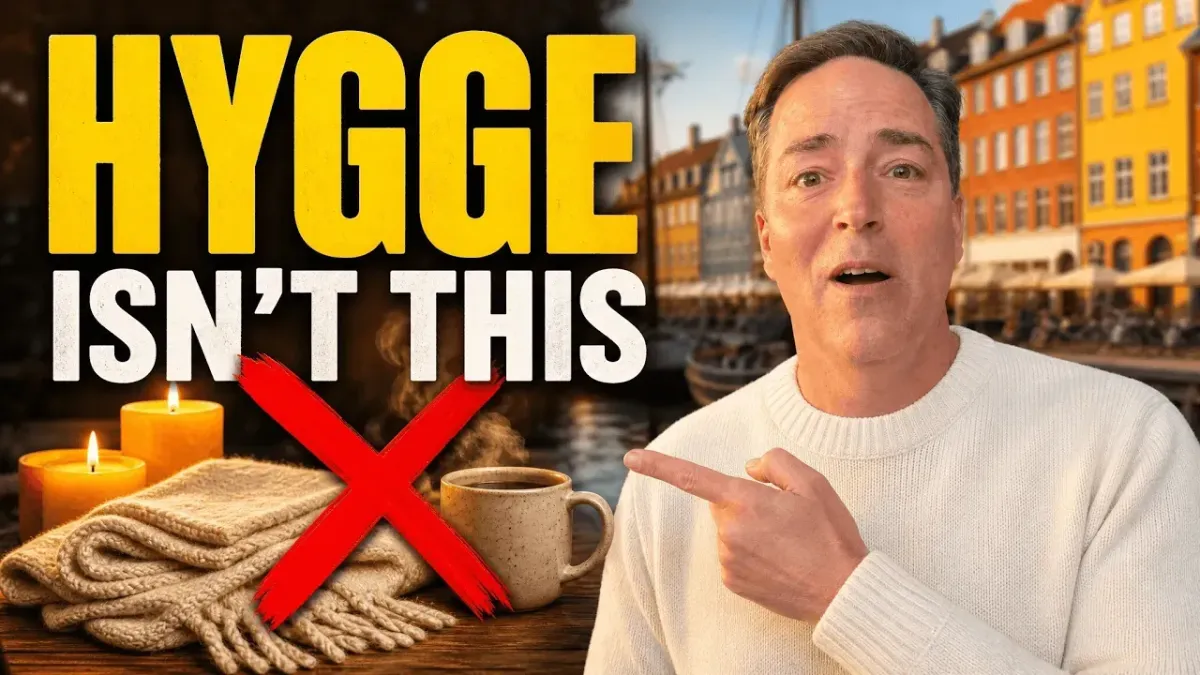
What is Janteloven? It's an unwritten Scandinavian social code that says you are not special — don't act smarter, richer, or more important than the people around you. Pete spent six days in Copenhagen trying to figure out why the place runs so well, came home convinced the answer was hygge, and then a restaurant server corrected him mid-dinner. The candles and the cozy are the output. Janteloven is the machine underneath.
What Is Janteloven, Exactly?
Janteloven, the Law of Jante, is an unwritten Scandinavian social code holding that no individual is more special, more important, or better than everyone else in the group.
That's it. No statute, no enforcement, nobody handing out tickets. It's the ambient pressure that makes a Dane downplay a promotion and makes bragging land like a bad smell. Danes will tell you it's fading. They will also tell you exactly who in their town is violating it.
Worth saying plainly: this is a cultural label, not a law and not a clinical concept. You won't find it in the Danish constitution. You'll find it in how people behave in a bike lane.
The Ten Rules Came From a Novel, and They Were Meant as an Insult
The part that surprises everyone, Pete included: Janteloven isn't ancient folk wisdom handed down from the Vikings. One guy wrote it in 1933.
Aksel Sandemose was a Danish-born novelist who moved to Norway and wrote in Norwegian. His novel En flyktning krysser sitt spor, published in English as A Fugitive Crosses His Tracks, is set in a fictional small town called Jante, which he modeled on Nykøbing Mors, the Danish town he grew up in and could not wait to leave. Inside the book, he spells out the town's ten commandments:
1. You're not to think you are anything special. 2. You're not to think you are as good as we are. 3. You're not to think you are smarter than we are. 4. You're not to imagine yourself better than we are. 5. You're not to think you know more than we do. 6. You're not to think you are more important than we are. 7. You're not to think you are good at anything. 8. You're not to laugh at us. 9. You're not to think anyone cares about you. 10. You're not to think you can teach us anything.
Read those again and notice the tone. Sandemose wasn't writing a values statement. He was writing an indictment — a portrait of small-town cruelty that suffocated him badly enough to leave the country. He handed Scandinavia a mirror, and Scandinavia adopted the mirror as a description of itself. Ninety-odd years later, the satire is the shorthand.
The Rule You Can See From a Bike Lane
Pete didn't read Sandemose. He got Janteloven from a server at an Italian restaurant in Copenhagen who had moved his whole family from London six or seven years earlier — London being great, in his words, and also big and stressful in a way he wanted out of.
Once Pete had the concept, he couldn't stop seeing it. Nobody honking. Nobody visibly late. Men in suits and women in work clothes pedaling to the office at a pace that suggested the office would still be there whenever they arrived. Pete's family, by his own admission, was the fastest-moving group on the street — and not because they were being rude, but because that's the American factory setting.
The clearest version of it might be Jonas Vingegaard, Denmark's best cyclist and a national figure. He won the Tour de France in 2022 and 2023 after working in a fish packing plant, which in most countries would be the setup for a decade of chest-beating. Pete found that bringing his name up in Copenhagen bars was a reliable way to make strangers light up. What he didn't find was anybody being loud about it.
The $10 Million Apartment With a Public Pool Next Door
The thing that made it click was a canal cruise. Copenhagen's guides do this route constantly, and Pete's guide, Michelle, floated the boat past Paper Island — Papirøen, officially Christiansholm — where the new apartments run into eight figures.
Pete's read was the obvious American one: rich people buying distance from everybody else. Michelle told him no. You can't wall off the water here. Denmark's planning rules treat public access along the shoreline as something a developer designs around rather than negotiates away, and a coastal protection line makes building right on the beach a non-starter nationally. So the island that spent nearly 300 years closed to the public (navy, industry, harbor traffic) reopens with a public promenade, a harbor pool, and a housing mix that includes smaller and cheaper units, all sitting next to the expensive ones.
Michelle's framing is the part that stuck with Pete. None of that is a gesture, and none of it is a handshake deal the developer volunteered for. It's the cost of being allowed to make money there.
Where the Law of Jante Falls Apart
Michelle also volunteered the counterexample, which is the reason we trust her.
North of the city sits North Zealand, a stretch of coastline running about 40 kilometers north from Copenhagen that holds some of the most expensive real estate in Europe and a lot of generational money. Danes have a nickname for it: the Whisky Belt, from back when whisky was the expensive drink in a country that runs on beer. Michelle's description of the people there was that they absolutely do believe they're better than everyone else. Her point wasn't that Denmark solved snobbery. It's that Denmark contained it — the same problem, in a smaller and less visible box.
Danes argue about Janteloven constantly, and not affectionately. Some of it gets blamed for flattening ambition and punishing anyone who tries something. Some towns have staged public ceremonies declaring the rules dead. A code that tells talented people not to think they're good at anything has an obvious downside, and the country is not unaware of it.
The Happiest Places Picked Their Rules
Six days and a lot of bar conversations add up to this. Denmark leads the world in interpersonal trust, with around 74% of Danes saying most people can be trusted, ahead of Norway and Finland. Copenhagen took the top spot on the Economist Intelligence Unit's 2025 liveability ranking with a score of 98 out of 100, ending Vienna's three-year run, with perfect marks in stability, education, and infrastructure. Denmark sits second in the World Happiness Report, behind Finland.
None of that is weather, and none of it is luck. It's the residue of a society that decided a long time ago that nobody gets to be the exception, and then built the laws, the bike lanes, and the harbor promenades to match.
Pete's honest conclusion was that he'd move there in a heartbeat and last about two seconds. He likes going fast. He likes the melting pot. Janteloven is the price of the calm, and it's a real price — the happiest places on earth aren't the ones with the fewest rules. They're the ones that picked their rules and stuck with them.
Episode 115 of Sorta Sophisticated is Pete unpacking six days in Copenhagen with Amanda asking the questions, and it covers a lot the postcard doesn't. There's the moment one of his kids yanked him out of a bike lane before he got flattened in his first fifteen minutes in the country, and there's the Viking king whose nickname ended up on every wireless device you own.
Hear the full episode here 👇 Copenhagen: The Postcard Lies A Little (Episode 115)
