What Does Selcouth Mean? The Old English Word for Strange in the Best Possible Way
What does selcouth mean? It means unfamiliar, strange, or rare — but with the dial turned toward wonder rather than suspicion. Something you've never encountered that turns out to be marvelous. It arrived as our word of the week the way most of them do: Amanda gets a word-a-day email, forwards the good ones to Pete, and Pete uses them. He owns up to the whole supply chain on-mic. Then he used it on-mic to explain why he never attempted a syllable of Danish in six days in Copenhagen.
What Does Selcouth Mean, Exactly?
Selcouth is a rare, archaic English adjective meaning strange or unfamiliar in a way that strikes you as marvelous rather than off-putting.
Dictionaries still carry it, flagged as rare, which is the most on-brand thing a word meaning "seldom known" could possibly do.
Seldom Plus Known
Pete had the roots right on the tape. Selcouth comes from Old English selcūþ, also written seldcūþ, built from seld- meaning rarely and cūþ meaning known. Literally: seldom known.
The seld- half is the ancestor of our word seldom, which is doing fine and shows up in normal conversation. The cūþ half had a bigger run. It's the past participle of cunnan, to know or to be able, which is the same family that gave English can, cunning, and the Scottish ken. In Old English, cūþ meant known, familiar, well-known — the word you'd use for a face you recognized.
English Kept the Insult and Threw Away the Compliment
Which brings us to the cousin everybody already knows: uncouth.
Old English uncūþ just meant unknown or unfamiliar. Over centuries the meaning curdled. Unfamiliar became strange, strange became awkward, and awkward became the guy chewing with his mouth open. Somewhere in that slide, English quietly lost the positive half of the pair.
Couth, meaning cultured or well-mannered, is a modern invention. It got reverse-engineered out of uncouth around 1896 by people who noticed the language had a negative adjective with no partner, and it has been used with a smirk ever since.
We ran into the same pattern in Episode 114 with impecunious, the polite Latin word for broke — English built and kept the discreet word for having no money, and let pecunious, meaning wealthy, sit in the dictionary doing nothing. The language is remarkably consistent about which half of a pair it bothers to maintain.
Walter Scott Wouldn't Let It Die
Pete's read on the tape was that nobody's touched selcouth since the 1500s, and the word did mostly fall out of use after Middle English. It got at least one great encore.
Walter Scott put it in Ivanhoe: "A selcouth novelty, to advance to storm such a castle without pennon or banner displayed." Scott was writing deliberate pseudo-medieval English and going through old vocabulary like a man at a flea market, and selcouth is exactly the kind of thing he came home with. Pete's ear pegged it as sounding like it belongs in a fantasy novel — that instinct is dead on. That register, knights and banners and half-understood marvels, is the last place the word was living.
Six Days of Selcouth
Then the word did something better than sit in the vocabulary segment. It turned into the through-line of the episode.
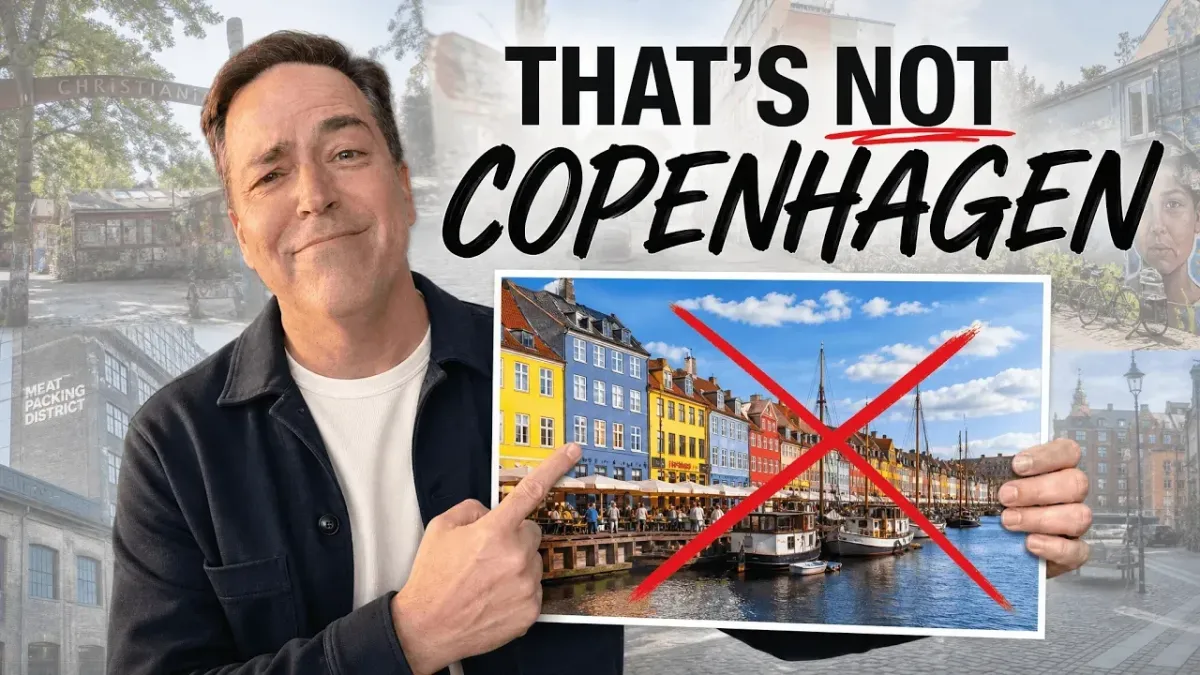
Consider Pete's first fifteen minutes in Copenhagen. He stepped out of the transfer van, walked onto what he assumed was a sidewalk, and discovered it was a bike lane — a raised strip between the road and the actual sidewalk, with its own curbs and its own walk signals. One of his kids grabbed him and yanked him out of the path of a cyclist who had no plans whatsoever to slow down. Terrifying. Then, once he understood the system, genuinely beautiful — three tiers of traffic, each with its own rules, all working.
Unfamiliar and strange, and then wonderful. That's the word.
It kept happening all week. The cash he'd carefully brought and never spent once, in one of the most card-driven countries on earth. The open-faced smørrebrød he ate with his hands like a barbarian before noticing that Danes use a fork and knife — the local equivalent of watching a tourist attack a hot dog with silverware. A self-governing commune tucked into the middle of the prettiest canal walk in the city, tolerated by the Danish government since 1971. A canal guide who dipped a cup into the harbor and drank it.
None of that is on the postcard. All of it was seldom known, at least to him.
A Word for What Travel Is Actually For
Selcouth deserves a comeback for a specific reason. English is generously stocked with words for unfamiliar-and-therefore-bad. Alien. Foreign. Weird. Uncouth. What we're short on is a word for unfamiliar-and-therefore-great, and that gap in the vocabulary shapes how people talk about being somewhere new.
Pete came back saying international travel makes him feel small — everyone speaks his language, he speaks none of theirs, and Danish schoolkids start English in primary school. He didn't frame that as humiliating. He framed it as being put in his place by people more capable than him, and he liked it.
That's selcouth: unfamiliar in a way that improves you.
Episode 115 of Sorta Sophisticated is Pete's Copenhagen trip, with Amanda asking the questions he didn't prepare for. It also covers why a Danish isn't called a Danish in Denmark, and the unwritten national rule that quietly forbids anyone from thinking they're special.
Hear the full episode here 👇 Copenhagen: The Postcard Lies A Little (Episode 115)
