What Does Mordant Mean? The Word That Bit People for 300 Years Before It Ever Bit a Fabric
Amanda's first guess is that it has something to do with death. A couple of minutes later Pete tries the word out on Michelangelo's mother dying and withdraws it mid-sentence, on-mic, before anyone can call him on it. So what does mordant mean? Sharply and bitingly critical — the wit that draws blood, not the mood that sits heavy. It's the word of the week in Episode 118 of Sorta Sophisticated, and the two wrong turns the hosts take on the way to it are the fastest route to remembering it.
What Does Mordant Mean, Exactly?
Mordant is an adjective describing criticism, humor, or wit that is sharp, biting, and incisive — cutting remarks delivered with precision rather than volume.
It comes through Old French mordant, the present participle of mordre, "to bite," from the Latin mordēre. Every use of the word is a metaphor about teeth. A mordant review has bite. A mordant colleague bites. Pete gets the root exactly right in the episode, and it's the load-bearing part: if a remark doesn't bite, it isn't mordant, it's just mean.
Amanda Guessed Death, Which Is the Neighboring Word
"I don't know. Something about death," Amanda says.
"No, that's like morbid," Pete tells her, and he's right, but the near-miss is worth a second because the two words really do live one street apart in the dictionary and nowhere near each other in the etymology.
Morbid comes from the Latin morbus, disease. Mordant comes from mordēre, to bite. Different roots, different jobs. Morbid is about what you're preoccupied with: death, decay, the grim stuff. Mordant is about how you say a thing. You can be mordant about a wedding. You can be perfectly cheerful and still be the most mordant person at the table.
And there's a third neighbor Pete accidentally summoned: he spells out M-O-R-D-A-N-T and then pronounces it mordent, which happens to be a real word too. A mordent is a musical ornament, a quick flick off a note and back onto it. Same Latin bite, borrowed by Italian, because the note takes a little nip at the one beside it.
The Chemistry Borrowed the Insult, Not the Other Way Around
The episode's version of this story and the dictionary's version part company here, and the dictionary's is more interesting.
Pete tells Amanda the word "originally showed up in English as a term for a chemical," meaning the substance that bites into cloth so a color will hold, and that the sense about wit came afterward. That's the version you'll find repeated in a lot of places. The dates run the other way. Merriam-Webster puts the adjective meaning "biting, caustic" in the 15th century and the dyeing noun at 1791. Etymonline agrees: caustic speech by the late 1400s, the dye fixative by 1791, and the adjective meaning "having the property of fixing colors" not until about 1902.
So English spent roughly three hundred years using mordant about people before it ever used it about fabric. When the dyers needed a name for the thing that grabs a color and won't let go, they reached for a word that already meant it bites.
There's an older sense still, from the mid-1300s, now fully dead: a mordant was the ornamented hooked clasp on a belt. The bit that bites the strap.
What a Mordant Actually Does to a Color
Amanda's other instinct in that exchange is the good one. She points at Pete's career in fashion and says the word feels like his territory ("well, chemicals"), and Pete waves it off. She's onto something real.
A mordant in dyeing is usually a metal salt: alum, iron sulfate, copper, tin. On its own, a lot of natural dye will sit on a fiber and then rinse straight back out. The mordant goes on first, bonds to the fiber, and then forms a coordination complex with the dye molecule — the fixative holding hands with the fabric on one side and the color on the other. What you end up with is an insoluble compound that the wash can't lift.
A mordant doesn't add color. It makes the color permanent, and that is the whole trick.
That is the best possible thing to know about the other meaning of the word, because it explains what separates a mordant remark from an ordinary insult. An insult stings and rinses out. A mordant line is the one somebody is still repeating about you years later, because it set.
Pete Used It Wrong on Purpose, Which Is How You Learn It
Two minutes after the word of the week, Pete is telling the story of Michelangelo's childhood: his mother Francesca dies when he's six, leaving his father to raise five boys.
"Talk about mordant," Pete says. Then, immediately: "What does mordant mean? Sarcastic and biting. No, it wasn't. It wasn't at all."
He tested the word on a sad fact, and a sad fact is not what the word is for. It's a better demonstration than a definition, and it's the mistake almost everyone makes with this one: reaching for mordant when they mean bleak, or dark, or heavy. A dead mother is tragic. The joke a grown man makes about it forty years later, with a knife in it, is mordant.
Amanda's verdict on the word, delivered less than a minute after learning it: "Who knew that you were mordant?"
Michelangelo Got Punched in the Face for Being Mordant
The episode's first fun fact is that Michelangelo's nose was permanently flattened by a fellow artist named Pietro Torrigiano. What the episode doesn't get to is why.
The account survives because Torrigiano later told the story to Benvenuto Cellini, who wrote it down. The two of them were teenagers copying Masaccio's frescoes in the Brancacci Chapel in Florence, and by Torrigiano's telling, "it was Buonarroti's habit to banter all who were drawing there; and one day, among others, when he was annoying me, I got more angry than usual, and clenching my fist, gave him such a blow on the nose, that I felt bone and cartilage go down like biscuit beneath my knuckles."
Michelangelo was mordant about other people's drawings, and it cost him the shape of his face for the next seventy-odd years. Every portrait of him has that punch in it.
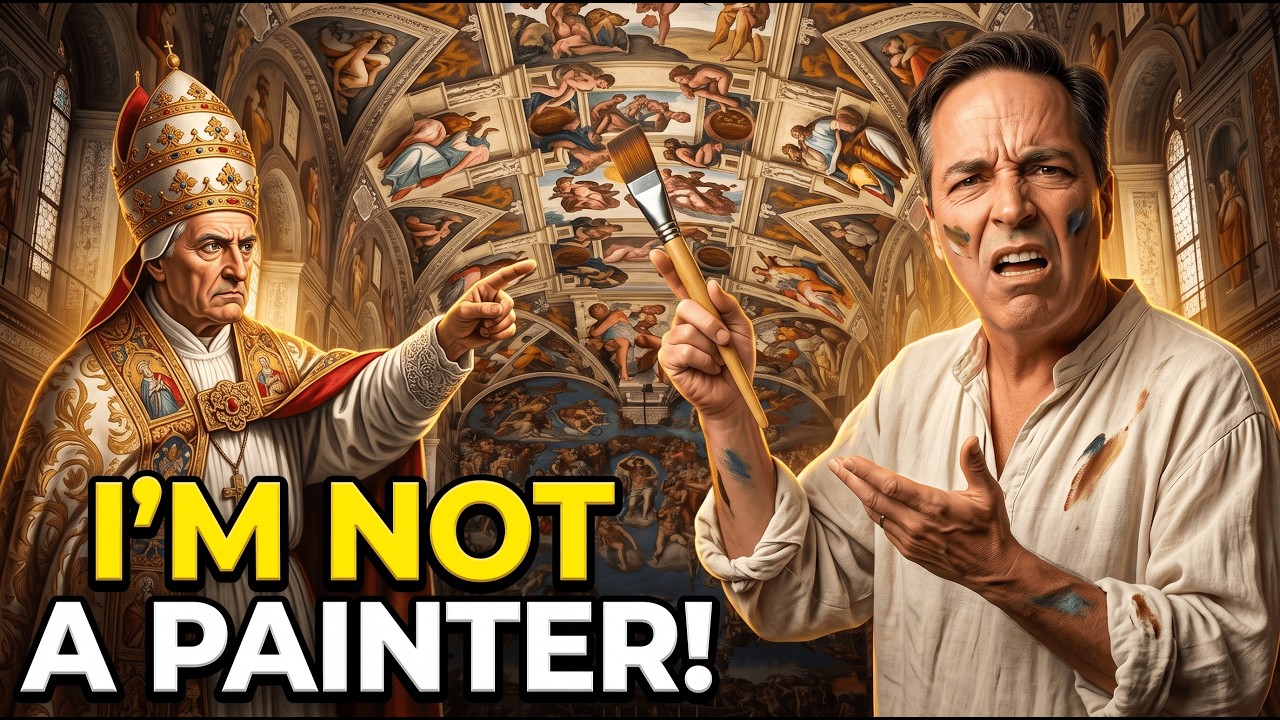
He never really stopped, either. Four years into painting the Sistine ceiling under a pope who wouldn't let him quit, he wrote a poem to a friend that ends: I am not in the right place — I am not a painter. Sarcastic, precise, aimed at himself and at his employer in the same breath. That's the word.
The Line That Doesn't Wash Out
Mordant is a rare thing in English — a word whose two meanings explain each other. The chemical sense tells you exactly what the conversational sense is doing. The mordant remark cuts and then bonds to the person, and the wash won't lift it.
Which is a decent argument for using it carefully. Michelangelo got a broken nose out of it. Whether that was worth it depends on how good the line was, and nobody wrote that part down.
Episode 118 of Sorta Sophisticated is the Michelangelo nobody teaches: a sculptor who got conscripted into painting by a pope and stayed furious about it for four years. Also in there: the nephew who smuggled his body out of Rome disguised as cargo, and the grand-nephew who quietly swapped the pronouns in his love poems before publishing them.
Hear the full episode here 👇 The Pope Forced Him to Paint: He Never Forgave Him (Episode 118)
