
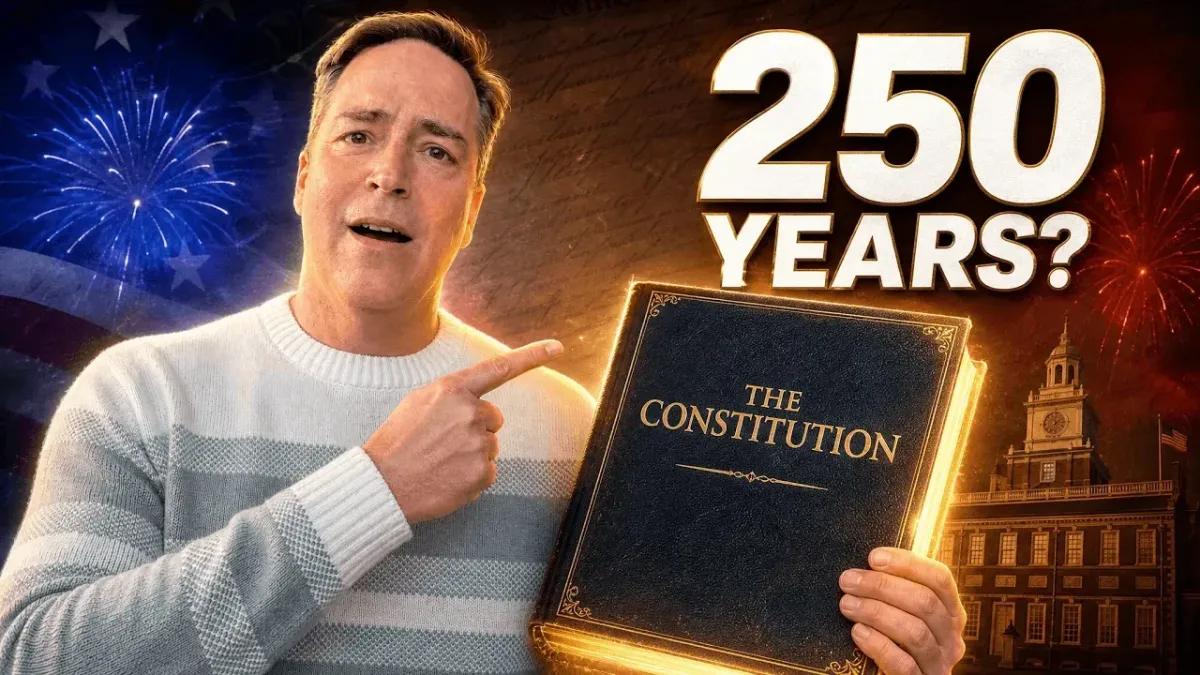
Was the Constitution Meant to Be a Rough Draft? The Debate America Forgot to Have
On July 4, 2026, America turns 250 — the semiquincentennial, if you want the word that’s nearly impossible to say out loud. There will be fireworks, parties, and plenty of flag-waving. But while researching Episode 110 of Sorta Sophisticated, we stumbled onto something that reframes the whole celebration: the founders never expected the Constitution to last this long. At least, one of them explicitly didn’t.
Jefferson’s Expiration Date
Thomas Jefferson wasn’t in the room when the Constitution was drafted — he was in France. But in a 1789 letter to James Madison, he made his position clear, writing that every constitution naturally expires after 19 years, and that enforcing one beyond that becomes an act of force rather than right. Why 19 years? Because that was considered a generation. Jefferson believed each new generation should be free to remake its government rather than live under the assumptions of the dead. In his words, the earth belongs to the living.
Madison’s Machine
James Madison — the “Father of the Constitution” — pushed back hard. He agreed the document shouldn’t freeze one generation’s beliefs in place forever, but he thought tearing up the constitution every two decades was a recipe for instability. His answer was a mechanism: the amendment process. Build a machine with a repair manual included, and you never need to scrap the whole thing.
Madison won the argument. And to be fair to him, the machine worked — for a while. The Bill of Rights came immediately. Slavery was abolished by amendment. Women won the vote by amendment. The document bent with history instead of breaking.
So Is It Working?
Here’s where our debate got heated, with special guest Steve Washington — a sixth-generation descendant of George Washington’s brother, John Augustin Washington (and yes, he brought the family tree and the Burke’s Presidential Families book to prove it).
The numbers are striking. Nearly 12,000 amendments have been proposed since 1789. Only 33 were ever sent to the states, and only 27 were ratified — ten of those all at once as the Bill of Rights. The most recent amendment, the 27th, was proposed in 1789 and took 203 years to ratify. The last genuinely new idea to make it into the Constitution is now more than three decades old.
One side of our debate says that’s a feature, not a bug. Amendments are supposed to be hard. A super-majority of 38 states has to agree, which means only causes with overwhelming national consensus — abolishing slavery, women’s suffrage — make it through. Be careful what you wish for: a constitution that changes fast is a constitution that changes with whoever happens to be in power. As Steve put it, the Constitution may be flawed, but it isn’t broken — the great experiment is still in progress.
The other side says we’ve quietly given up on Madison’s machine. The Civil War proved the danger of treating the text like scripture: the Union argued the Constitution prohibited secession while the Confederacy argued the same document protected states’ rights — both sides quoting the same words to justify opposite positions. If we treat the Constitution as a finished monument instead of a living machine, we stop doing the maintenance the founders explicitly asked of us.
The Question They Left Us
Maybe the real answer is the one we landed on by the end of the episode: the mechanism still works — it’s the operators who’ve changed. The founders were brilliant, flawed, sometimes hypocritical humans who had the courage to write down what a just society should look like and the humility to admit they probably got some of it wrong. The one thing they asked of every future generation was to keep editing.
Hear the full debate — including the 1619 Project controversy, Alexander Hamilton’s secret contempt for the document he sold to America, and what it’s like growing up a Washington — on Episode 110 of Sorta Sophisticated: “The Real Work Starts After the Fireworks.”
Watch the full episode here 👇
