The Tip Screen Isn't Asking You a Question. It's Running an Experiment on You.
You’re buying bagels at eight in the morning.
You did nothing wrong. You ordered, they boxed six things, you went to pay.
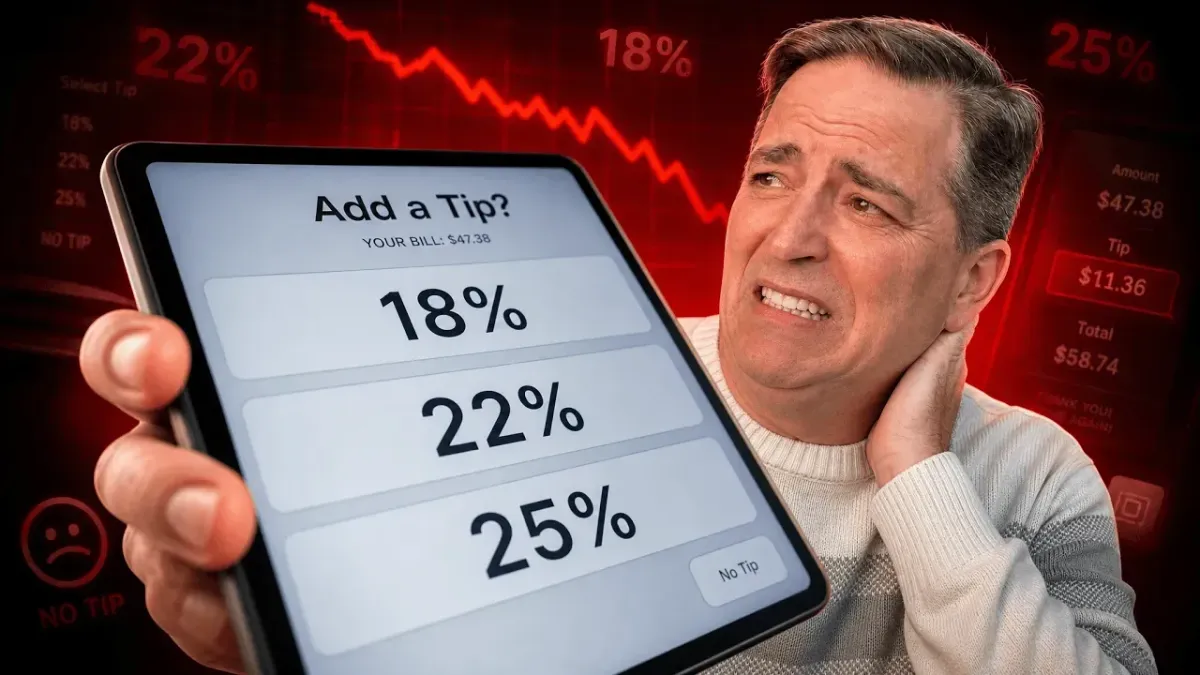
Then the iPad spins around. 18%. 20%. 25%. And somewhere down in the corner, in tiny gray letters you’d never find unless you knew to look, “No Tip.”
And the person who handed you the bag is watching.
You hit a number. You walk out. And you feel judged — for something that, ten minutes ago, you didn’t even know you were supposed to feel.
Here’s the thing nobody tells you: that feeling isn’t an accident. It’s engineered.
The Part Everyone Gets Wrong About Tipping
Most people assume tipping is about generosity.
It isn’t. It never really was.
The practice drifted over from England in the 1600s — little boxes on tavern tables, a bit of extra change to get your drinks faster. Then it crossed the Atlantic with wealthy Americans trying to look sophisticated and keep up with the British.
But the version we actually live with today was born somewhere much uglier: post–Civil War America. Restaurants and railroads realized they could hire a newly freed workforce and pay them almost nothing — then pass the cost of those wages directly onto the customer.
Tipping wasn’t a thank-you. It was a wage dodge.
And somehow, a century and a half later, we’re still running the same system and calling it manners.
The Two Moments That Broke It
For most of the 20th century, tipping sat at a stable, sane 10–15%. You got a paper receipt. You sat at the table. You decided privately, after the meal, with nobody hovering.
Then two things happened, fast, right around the year 2000.
First, the iPad. Square, Toast, and the rest of the point-of-sale world put a screen between you and the door — and put the tip prompt on it before you leave, while a human stands there waiting.
Second, COVID. “Support your local restaurant.” People felt guilty, started tipping on takeout, started tipping on everything. That’s the exact moment 15% quietly became 18%, then 18% became 20%, and we never went back.
The baseline reset. And nobody voted on it.
The Guilt You Feel Has a Name
There’s actual research here. When that screen faces the customer, tips jump 20–30% compared to when people decide privately.
The reason is a documented phenomenon called social facilitation: people change their behavior when they believe they’re being watched.
That’s not a coincidence. That’s a deliberate application of social psychology, pointed at your wallet, several times a day.
So if you’ve ever stood there feeling cheap for hesitating — you weren’t being cheap.
You were noticing.
The Stuff That Has Nothing to Do With Service
Cornell’s Michael Lynn spent decades studying what actually moves a tip. The findings are uncomfortable.
Drawing a smiley face on the check.
Handing you a piece of candy.
Squatting down to your eye level.
Lightly touching your shoulder.
All of these measurably increase the tip. The food is identical. The service is identical. But the candy showed up, so now you’re at 22%.
Tipping, it turns out, correlates with the server’s attractiveness, race, and gender far more than with the quality of the work.
We are deeply, demonstrably irrational about this. And the irrationality is the product.
The Leadership Lesson Hiding in the Bagel Shop
Here’s the part that has nothing to do with restaurants.
We built a system that quietly transfers the moral weight of paying workers off of corporations and onto individual customers — and then makes those customers feel guilty for pushing back on it.
That’s a design choice. And it’s a pattern you’ll see everywhere once you spot it: costs offloaded onto whoever feels the most social pressure to absorb them, dressed up as a question of character.
The most honest thing you can do isn’t to tip more or tip less.
It’s to notice when a “personal choice” was actually manufactured for you.
Why This Matters
To be clear: I’m not anti-tipping. Tip well for genuinely good service. Tip the people everyone forgets — housekeepers, drivers, the ones doing real work. Use your judgment. You’re an adult.
But the next time the screen spins around, take one second.
Not to feel bad. Just to make an actual decision instead of a reflex.
Was it good service? Or was it a drip coffee handed over a counter?
You’re allowed to know the difference.
If you want the curious, slightly chaotic, occasionally heated version of this conversation — Amanda and I go all the way from medieval England to the iPad guilt screen in about thirty minutes on this week’s episode of Sorta Sophisticated.
🎧 Listen here: