
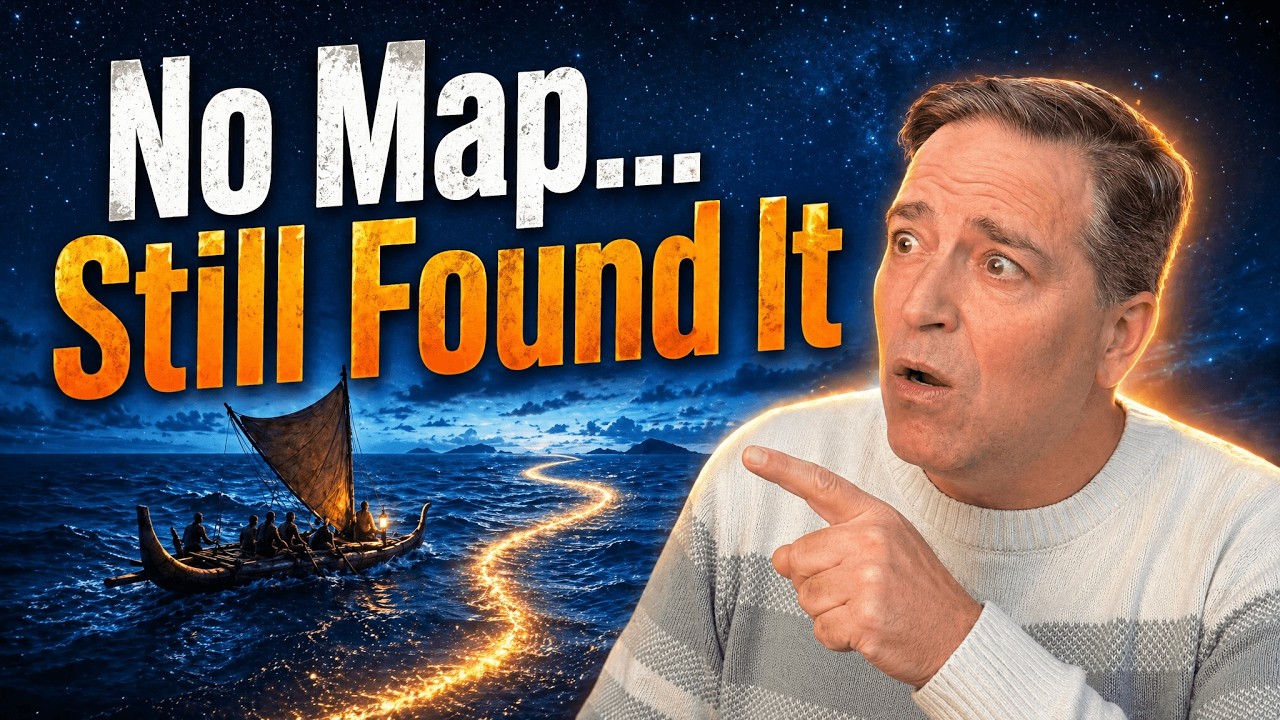
They Had No Compass, No Map, and Found Tahiti Anyway: The Voyage That Revived a Culture
They Had No Compass, No Map, and No Business Finding Tahiti — And They Found It Anyway
In 1976, a 62-foot wooden canoe left Hawaii bound for Tahiti — roughly 2,500 miles of open ocean away. There were about fifteen people on board and not a single navigation instrument. No GPS, no satellite, no radar, no radio. Nothing. The man guiding them came from a tiny island in Micronesia and had never sailed to Tahiti in his life. Thirty-three days later, the canoe sailed straight into the harbor at Papeete as if it had made the trip a hundred times before.
This episode of Sorta Sophisticated isn’t really about a canoe doing the impossible, though that alone is remarkable. It’s about a culture that very nearly disappeared — and then decided not to.
A Culture on the Edge of Extinction
By 1970, the Hawaiian art of wayfinding — open-ocean voyaging by reading the natural world — was effectively gone. And it wasn’t just the navigation. After roughly 200 years of colonization, missionary efforts that dismissed and suppressed native traditions, annexation, and eventual statehood, Hawaiian culture itself was hanging by a thread.
Consider this: by 1970, only around 2,000 people still spoke fluent Hawaiian, and most of them were elderly. Traditional ceremonies had been stripped away. At one point hula itself was outlawed. When you break the systems that carry a culture — especially the oral traditions, the storytelling passed down through communities and generations — the knowledge doesn’t just fade. It vanishes. And wayfinding vanished with it.
The Pacific Was Settled on Purpose, Not by Accident
For a long time, Western historians assumed Polynesians had simply stumbled onto the islands of the Pacific by drifting. The thinking went: the ocean is impossibly vast, these people had no instruments, so they must have gotten lucky.
That assumption turned out to be wrong, and the proof is fascinating. Researchers ran computer simulations of random ocean drift patterns. When they let virtual canoes drift wherever the currents and winds carried them, none of the simulations matched how the islands were actually settled. But when they modeled intentional wayfinding, the simulations lined up with the real settlement pattern perfectly.
How do we know the real order? Archaeologists dated artifacts across these tiny islands, establishing which were settled when. That order runs against the prevailing winds and currents — not with them. And that’s the giveaway. Drifters go with the wind. Navigators sail into it, because heading into the wind means that if something goes wrong, you can turn around and ride it safely home. The Polynesians settled an area larger than North America, island by island, entirely on purpose.
How Wayfinding Actually Works
The navigators spent their entire lives learning to read the ocean and sky. Near land, everything changes — the currents, the wind patterns, the cloud formations, the behavior of birds. A skilled wayfinder could detect a landmass up to 50 miles away without seeing a thing, just by reading those shifts. Clouds cluster over islands. Certain birds signal that land is near.
The first explorers had no folklore to follow at all. They simply set out, the way explorers always have. They’d sail a few hundred miles, maybe spot a sign of something, then turn back to stay safe. They’d tell the next group what they saw — unfamiliar birds out past a certain point, for instance — and that group would build a bigger canoe and push a little further. Generation by generation, they extended the map in their minds until the whole Pacific was known.
Finding the One Man Who Still Knew
In 1973, three men — Ben Finney, an anthropologist from California; Tommy Holmes, a sailor; and Herb Kawainui Kāne, a Hawaiian artist — founded the Polynesian Voyaging Society. Their goal was to build a traditional double-hulled canoe and prove it could once again sail by wayfinding alone.
The effort was controversial at first; some Hawaiians bristled at the idea of outsiders leading a revival of their own tradition. But the intention was genuine, and as the project took shape, support grew. Herb named the canoe Hōkūleʻa, after Arcturus, the “Star of Gladness” — the zenith star that passes directly overhead the Hawaiian Islands. When navigators saw Arcturus straight above them, they knew they were at Hawaii’s latitude and could sail home. They launched the 62-foot canoe off Oʻahu in 1975.
But there was a problem. Tommy Holmes was a sailor, not a wayfinder, and no native Hawaiian alive knew how to navigate the old way. So they went looking. A New Zealand doctor and sailor named David Lewis had spent time among the last wayfinders and written a book about it, We, the Navigators. Through that trail, the society found Pius “Mau” Piailug on the tiny island of Satawal in Micronesia — one of only six master wayfinders left alive on Earth. Mau, who feared the knowledge would die with his generation, agreed to go. He’d never been to Tahiti and had no idea how to get there. He went anyway.
“I Trust the Teachings of My Ancestors”
Before they left, some skeptics asked Mau how he could possibly find an island he’d never seen, on a route no one had sailed in centuries. His answer, in essence: he trusted the teachings of his ancestors, and that faith was what would carry them there.
And it did. Mau had memorized roughly 150 stars — their positions and patterns across the sky every night. At sunset he’d pick a star low on the horizon, a “star house,” and set course by it. When that star climbed too high to be useful, he already had the next one chosen, following them all night as the Earth turned. During the day, with no stars to guide him, he read the sun’s angle and the ocean swells. He would lie down in the hull of the canoe and feel the vibration of the waves against it, judging by their angle whether they were still holding the right latitude. For 33 days, across 2,500 miles, he did this.
A Harbor Full of People
When Hōkūleʻa sailed into Tahiti, no formal ceremony had been planned. It didn’t matter. Word spread, and roughly 17,000 people — more than half the population of the island — came to the shore to witness it. The elders of Tahiti had kept the old stories alive, the names of ancient wayfinders and their canoes. Seeing the voyage completed again, after something like 600 years, was overwhelming. It connected a living people to a heritage they’d been told was lost.
The Voyage That Brought a Culture Back
The trip wasn’t entirely smooth. Tensions ran high between crew members trying to “prove” the voyage and the native Hawaiians who were living it, and conflict broke out more than once. Mau actually flew home rather than sail back, and a different crew handled the return leg. But what happened next eclipsed all of it. The return of Hōkūleʻa is widely credited with sparking the Hawaiian Renaissance — a full revival of the language, hula, traditional music and crafts, and Hawaiian identity itself. Immersion schools reopened. The culture came rushing back.
One crew member who sailed both legs put it perfectly: they left as sailors and came back as Hawaiians.
A young crew member named Nainoa Thompson became so captivated that he traveled to Satawal to study under Mau for years. In 1980 he became the first native Hawaiian in modern history to navigate from Hawaii to Tahiti using traditional methods. Today he leads the Polynesian Voyaging Society and has trained a whole new generation of wayfinders across the Pacific.
Still Sailing
Since 1976, Hōkūleʻa has logged more than 250,000 nautical miles, including a full circumnavigation of the globe between 2013 and 2017 — 47,000 miles, 26 countries, blessed by the Dalai Lama in India and Archbishop Desmond Tutu in South Africa. A wooden canoe with no instruments sailed around the entire planet. As of this episode, it’s midway through another voyage around the Pacific, connecting hundreds of crew members from dozens of countries.
This year marks the 50th anniversary of that original voyage. The canoe is still sailing, and the knowledge that nearly slipped away is now being carried forward. We’re all better for stories like this one.
Want to dive deeper? Watch the documentary “Papa Mau: The Wayfinder” on Mau’s life, or read “Hawaiki Rising” by Sam Low for the full story of Hōkūleʻa. You can even track the canoe’s current position online.
🎧 Listen here:
