
The Unwritten Rules That Control Your Life (And You Don't Even Know It)
From the Sorta Sophisticated podcast — where culture, curiosity and chaos collide. This post is adapted from our episode on the unwritten rules that quietly run your life.
It started with a fight about tipping and a guy merging in front of me on the freeway. Somewhere between “how much do I actually owe this server?” and “wait, do I even own the space in front of my car?”, it clicked: our whole society runs on rules nobody ever wrote down. No law, no memo, no vote — and yet we all mostly follow them, and we quietly judge the people who don’t.
Sociologists call these social norms. We called them unwritten, non-negotiable rules and then spent an entire episode arguing over the “right” answers — because the fascinating part is that we all have slightly different ones. Here’s where we landed, category by category.
Social rules
How long do you have to stay at a party? Forget the clock. The real minimum is: stay long enough to have a drink and, if there’s food, eat some food. Do that, and you’re free to go with a clear conscience.
Can you do the Irish goodbye? Leaving without saying goodbye isn’t rude — it’s situational. Always say hi and acknowledge the host when you arrive. But if you’re slipping out earlier than expected, sneaking away quietly is often the considerate move, because a big public goodbye makes your exit about you. The trick is size: at a party of 20 or more, ghost away freely. At an intimate gathering, your absence is a murder-mystery-level clue, so say goodbye.
When do you stop saying “happy birthday” if you missed it? This one has nothing to do with time and everything to do with circles. For your inner circle, there’s no expiration date — you own the mistake and say it late (maybe with a gift to make up for it). For the outer ring, you just… let it go. It’s about the layers of the onion, not the calendar.
Should you tell someone they have food in their teeth (or their fly’s down)? Yes. Every time. You’re not embarrassing them — you’re saving them. The small cringe of being told beats walking around all night wondering why nobody said anything.
How many times do you invite someone before you give up? The three-strike rule: three flakes and you’re voted off the island. But there’s a crucial asterisk — legitimate excuses don’t count as strikes. As we put it: four balls, three strikes. Real life gets a walk; chronic flaking gets you benched.
Money rules
Who pays? The verb tells you everything. If someone says “let me take you to lunch,” take means they’re paying. If it’s “let’s go to lunch,” that’s a 50/50. English is doing quiet contractual work in that one word.
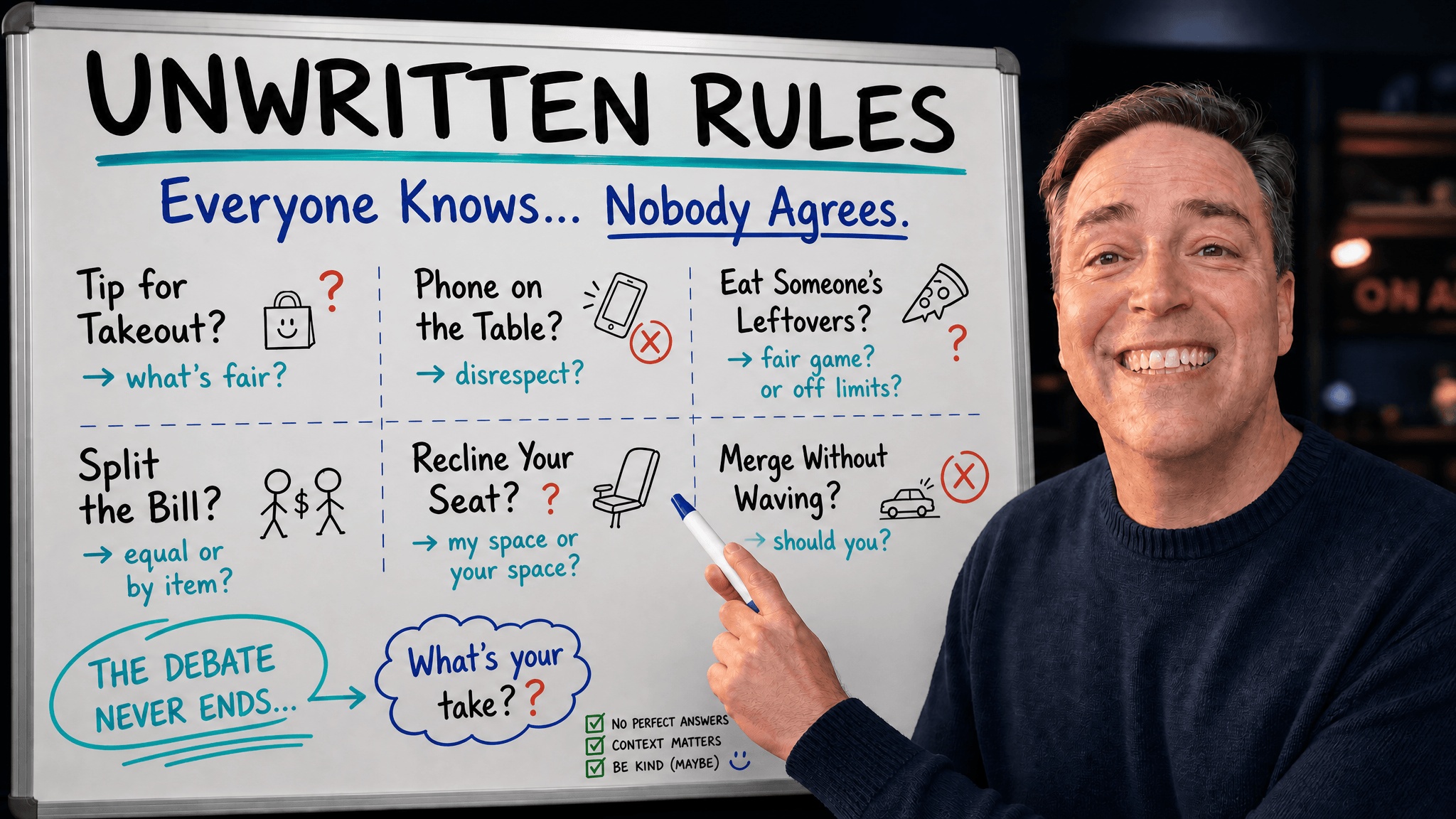
Splitting the bill when someone orders the market-price lobster and you got the chicken? The rule is to give yourself an out early. If the imbalance is going to bug you, say something before the check lands — “want to just get separate checks?” or “I’ll Venmo you my part.” Wait until the bill hits the table and you’ve lost your leverage; now you either eat the 50/50 or look like the person nickel-and-diming at the end.
Do you tell friends what you make? Broadly, no — and it seems to be generational. Older generations hold that number close; money mixed with friends and family gets complicated fast. If you must gesture at it, ballpark it (“under six figures,” “over six figures”) instead of naming a number.
Is it rude to ask what something cost? Generally, yes — unless you’re genuinely in the market for the same thing. Asking about someone’s car because you’re about to buy that exact model is research. Asking just to know is nosy. Intent is the whole difference.
Friend rules
Do you return a dish empty? If someone left a plate behind after a party, returning it clean and empty is totally fine — the dish was just along for the ride. But if a friend intentionally gave you a container of homemade cookies, the kind move is to send it back with a little something inside. Not required, just nice.
Can you cancel plans because you’re just tired? Honesty beats a fake excuse — most people would rather hear “I’m wiped, I need to bail” than a transparent fib. The caveat is patterns: grace is infinite for a rough season, but if canceling becomes your default, that’s a different conversation. Bonus move we loved: instead of forcing the tired friend out, you show up at their door with takeout and offer to just watch TV on the couch.
Do you have to attend every wedding you’re invited to? Use a barometer for closeness: if something serious happened in your life, would you tell this person? If yes, you go — even if you have to fly. If they’re a “our-parents-invited-them” tier acquaintance, the honest answer is that closeness, not obligation, decides it.
Should friends tell you the hard truth? Yes — if they’re in your circle. The bar is high (think health concerns, or real red flags about someone you’re dating), and the delivery matters: a good friend checks in gently first rather than blurting. But if a friend won’t tell you the hard thing, who will?
Travel rules
Stinky food on a plane? Don’t. Learn from the one who did it once with airport Indian food and has never recovered from the cringe.
Armrests? The middle seat gets both armrests, by default. They have no window to lean on and no aisle to stretch into — it’s the one advantage the worst seat gets. Everyone else picks a side.
Reclining? Fine on a long flight or if you’re actually going to nap. Not okay to fully recline for a two-hour hop just to watch a show — sit up. (One of us has a hard 90-minute rule: under that, no reclining, and mild rage at anyone who does.)
Swapping seats so a family can sit together? These days you paid to pick your seat, so nobody’s obligated to give up a window for a middle. That said, there’s grace for a parent traveling with a young kid — and for kids under a certain age it can actually be an airline rule, so the kind move is to clear the swap with the gate agent rather than expecting a stranger to just eat the downgrade.
Saving pool chairs? Holding one or two loungers to stash your stuff is fine. Draping towels over six chairs at 7 a.m. and vanishing for three hours is anarchy. The rule: someone from your party has to actually be using them. One person stays as tribute.
Technology rules
Phone on the table at dinner? Having it on the table is fine — just don’t look at it. Be present with the people you’re with. (Yes, this is hard. It’s a rule worth struggling toward anyway.)
Speakerphone in public? No. Nobody at the grocery store signed up for your conversation. If it’s not an emergency, “let me call you back” is the move. A little grace for older folks who genuinely can’t hear — but the answer is to step aside and keep it short, not to broadcast a recipe swap down the cereal aisle.
Everyday rules
Return the shopping cart? This is the big one — basically a character test. The gold standard is walking it back to the front of the store; the cart-return corral is a perfectly acceptable second place. Abandoning it in the middle of the lot? That’s heathen behavior, and you know it.
Merging and the wave? Zipper merge, and be courteous. You don’t have to wave if you merged smoothly. But if you forced someone to brake or swerve, you owe them the apology wave. (Waving costs nothing and dramatically lowers your odds of a road-rage incident, so honestly — just wave.)
Tip on takeout? Reasonable people land at “only for the regular spots” — the family restaurant you’re loyal to. A one-off counter order where someone hands you a bag? Optional at most.
Eating leftovers from the office fridge? Always ask. If it’s been sitting for days, the only acceptable move is the trash, not your mouth. And at home, one of us runs an “18-hour rule” for kid-to-kid leftovers: the person who ordered it gets first dibs until roughly the next evening, and after that it’s fair game for the whole house.
The surprising science behind all of it
Here’s what makes these rules more than random quirks. British anthropologist Robin Dunbar found in the 1990s that the human brain can only maintain about 150 stable relationships — now known as Dunbar’s number. Below 150, a community is small enough to hold people accountable face to face. Above it, you lose that direct accountability — so unwritten rules step in to do the enforcing. Our brains evolved to police these norms back when breaking them had life-or-death stakes.
That’s also why norm-breaking makes us weirdly furious. The broken windows theory (Wilson and Kelling, around the same era) argues that one unfixed violation invites more — so we’re wired to react. And here’s the twist: we’re not actually mad that someone broke the rule. We’re mad they’re getting away with it. The caveman alarm still fires; it’s just that the threat used to be a predator and now it’s a guy who didn’t wave after merging.
A few fun facts to sound sorta sophisticated
- The merge wave only dates to the 1950s — not the invention of the car, but the moment car windows got easy to roll down. Before that, waving thanks was too much of a production.
- “Don’t discuss money or politics at dinner” comes from Victorian England in the 1880s — tied to class anxiety about where one’s money actually came from.
- We lower our voices in libraries, hospitals, and churches almost universally across cultures. Researchers think it traces back to staying quiet around sleeping or injured group members so you didn’t attract predators.
- The two-drink minimum isn’t a law — it’s just a norm bar owners adopted so people wouldn’t camp on a table sipping water all night.
- “Always bring a gift to a dinner party” isn’t universal. In Japan, a gift can create social discomfort, because the host now feels obligated to reciprocate appropriately. Different rules, different cultures, same humanity.
Want to go deeper? Two great starting points: The Unwritten Rules of Social Relationships by Temple Grandin and Sean Barron, and just about anything by sociologist Erving Goffman, who argued we’re all essentially performing for each other, all the time.
Five things to remember so you sound sorta sophisticated
- Unwritten rules are what sociologists call social norms, and almost none were designed on purpose. They emerged through repetition and imitation until the behavior became the expectation. Nobody voted. Nobody wrote anything down.
- Breaking one carries a real cost even with no enforcement mechanism — the punishment is shame, judgment, or quiet social exclusion, which for most humans is punishment enough.
- Some rules we assume are ancient are surprisingly recent: no-phones-at-dinner is about a decade old, the merge wave barely predates Elvis, and “don’t discuss money” is only around 150 years old.
- The most revealing question isn’t whether you know a rule — it’s your instinctive reaction when someone breaks it. That reaction tells you where the rule actually lives: not on any page, but inside you (and it’s different person to person).
- The shopping cart return isn’t etiquette. It’s a character test with no proctor in the room — and you know it. So just do it.
The unwritten rules are the invisible architecture civilization actually runs on — not the legal stuff, the stuff you just know. So next time someone doesn’t wave after the merge, give them a little grace. Maybe they just moved here. Maybe they didn’t know. Either way, you waved — and that’s the rule. Stay curious, stay kind, and be excellent to each other.
Watch the full episode on YouTube: Episode 112 — The Unwritten Rules That Control Your Life (And You Don’t Even Know It)
