
Miles Davis Didn't Use His Genius to Get Famous. He Used It to Quit.
Miles Davis would have turned 100 this week.
And the more I dug into his life, the more I realized I’d had him completely wrong. I thought the story was “great jazz musician.” It isn’t.
The real story is what it costs a person to refuse to comply with the machine — over and over and over again.
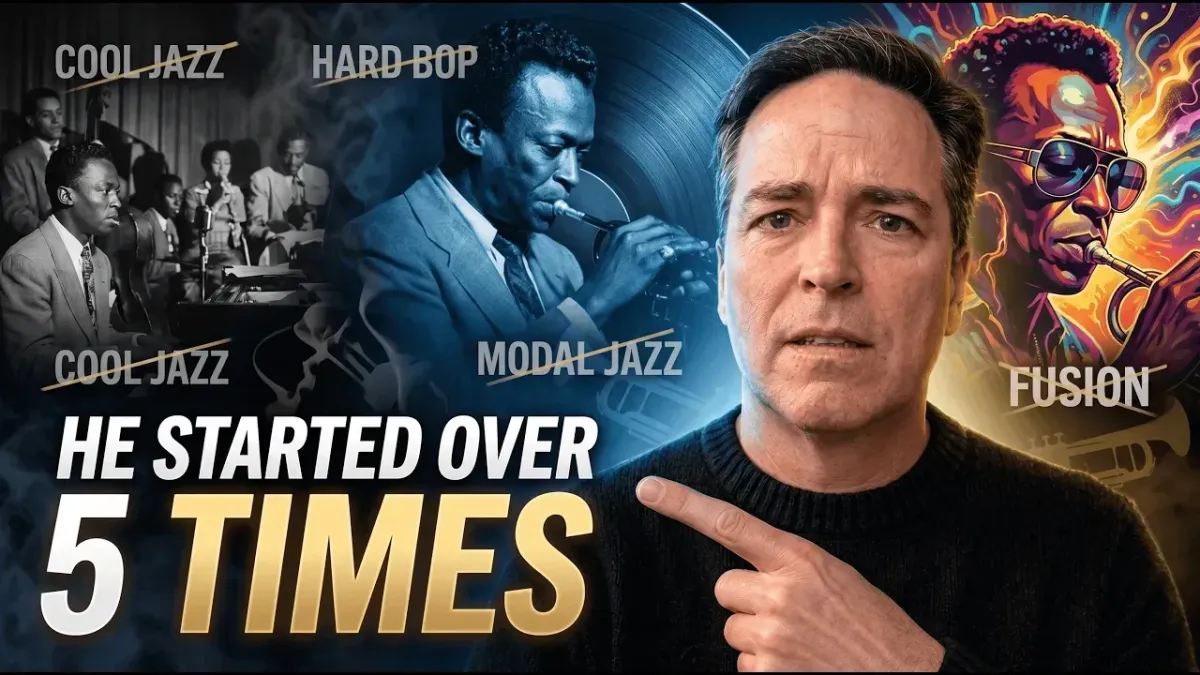
Because here’s what Miles Davis actually did, that almost no one in music history has done: he reached the top of a genre, then blew the whole thing up and started over. Then he did it again. And again. Five times, maybe six.
Most geniuses find their voice and go deeper. Frank Sinatra, Elvis, Michael Jackson — they followed the thing they were great at and refined it for a lifetime.
Miles went sideways. On purpose. Every time it started working.
The Part Nobody Tells You About Miles Davis
If you picture jazz as something born purely from hardship and the streets, Miles breaks the stereotype immediately.
His father was an accomplished dental surgeon. His mother was a trained musician. They had a house, and a separate farm in Arkansas. He grew up with money.
At 17, two of the biggest names in jazz — Dizzy Gillespie and Charlie Parker — came through St. Louis, their trumpet player got sick, and a local kid got pulled up on stage. That kid held his own next to the giants. Then he followed them to New York, enrolled at Juilliard, dropped out after three semesters because the clubs were the real education, and became famous playing bebop.
That’s not the reinvention story. That’s just the prologue.
Five Reinventions
Here’s the pattern. Watch it repeat.
Cool jazz. Around 1949, already famous, he assembles a nine-piece band with a French horn, a tuba, a trombone — instruments that did not belong in a jazz group. He invents a softer, quieter genre that didn’t exist. The bebop crowd is baffled.
Hard bop. A few years later — after kicking a serious heroin addiction cold turkey at his father’s farm — he shows up at Newport, plays “Round Midnight,” and signs with Columbia on the spot. New sound. New genre.
Modal jazz. He throws out the entire harmonic system jazz was built on — the chord changes everyone chased — and just parks on a single scale, a mood. The result was Kind of Blue, the best-selling jazz album in human history, which rewired how every musician on earth thought about improvisation.
Jazz fusion. Late '60s. Rock is exploding. He picks up an electric guitar and synthesizers, records Bitches Brew, and opens for the Grateful Dead. The purists scream “sellout.” It lands on the mainstream Top 40 anyway.
Pop/funk jazz. Mid-'80s. He layers his trumpet over drum machines and synth-pop, releases Tutu (named for Desmond Tutu), and wins two Grammys.
Every single time, the people who loved his last sound felt betrayed by his next one. And every single time, a whole new audience showed up to replace them.
There’s a quote that sums him up perfectly: “Don’t play what’s there. Play what’s not there.”
What It Actually Cost Him
Let’s not romanticize this into a clean hero story. It cost him a lot.
Each reinvention torched part of his fanbase. By 1975 he was exhausted, sick (he was born with sickle cell anemia), and broke — the family money was long gone. He disappeared completely for five years before coming back for that final act.
And he was not a good man in the ways that matter most. Married and divorced three times, and violent toward the women in his life. That part is real, and it belongs in the story.
The lesson here isn’t “be like Miles.” It’s narrower than that, and more useful.
The Leadership Lesson
We live in a culture terrified of being found out.
Our egos want us to look like we have it all together. We can’t afford to be visibly bad at something. So we don’t try anything new — because trying means risking the discovery that we’re beginners again.
That fear keeps most of us in one small, safe box for an entire career.
Miles felt none of it. Partly that’s temperament, and partly — let’s be honest — it’s that his upbringing and reputation meant he never needed the industry’s approval. He had a foundation under him most people don’t.
But the principle survives even without the privilege: the people who keep growing are the ones willing to be a beginner again, in public, after they’ve already been declared an expert.
Why This Matters
Here’s the harder, more personal question the episode left me with — and it has nothing to do with jazz.
Are the people in your life allowed to change?
Or do you quietly punish them when they try? Do you keep your colleague, your partner, your kid pinned to the version of them you already figured out — the version that’s easiest for you to deal with?
Reinvention isn’t just a gift. It’s a choice. And it costs something every time.
The most sophisticated thing you can do may be to walk away from what you’re best at, right when everyone’s finally agreed how good you are at it.
If you want the full, chaotic, slightly star-struck version of this conversation — plus the story of the love affair that’s becoming a movie — it’s all on this week’s episode of Sorta Sophisticated.
🎧 Listen here: