Marilyn Monroe Was the Smartest Person in Every Room. The Room Never Figured It Out.
When I say Marilyn Monroe, you already have the picture.
The white dress over the subway grate. The breathy “Happy Birthday, Mr. President.” Platinum blonde, arguably the most photographed woman in the world.
She would have turned 100 this week. And here’s what struck me as I went down the rabbit hole: we have reduced one of the most photographed humans in history down to a body and a punchline, and we know almost nothing about the actual person.
So let me make the argument that the “dumb blonde” was a character she built, ran on purpose, and used to beat a system that thought it was using her.
Norma Jeane: A Survival Story, Not a Glamour Story
She was born Norma Jeane Mortenson in Los Angeles in 1926. Her mother was institutionalized with schizophrenia for most of her life. Her father bolted before she was born.
She grew up through a string of foster homes and a stint in an orphanage — one that, in a detail you couldn’t write, sat across the street from a movie studio she’d stare at and dream about.
At 16, when her foster family decided to leave the state and couldn’t take her, she avoided going back to the orphanage the only way available to her: she got married. She literally went door to door in the neighborhood. Her own description of that first marriage was that she was “dying of boredom.”
By 18, with her husband shipped off to World War II, she was working in a munitions factory in Van Nuys when a photographer walked in to shoot a piece on women supporting the war effort.
She lit up in front of the camera. And then she went home and taught herself — studying her own photos, figuring out exactly what the lens wanted, the way kids reverse-engineer social media today. She got rejected by Fox, Columbia, and RKO before any of it worked.
Nobody discovered her. She built her.
Four Moves That Were Genuinely Radical for Her Time
This is the part that gets skipped.
1. She walked out on Fox and started her own company. In 1954, at the peak of her fame, she was making around $1,500 a movie while male co-stars made hundreds of thousands. She knew she was the draw. So she left, moved to New York, studied method acting under Lee Strasberg, and founded Marilyn Monroe Productions. She made one film, proved her value, and forced Fox to come crawling back and rewrite her contract on her terms. That is not a dumb blonde. That is leverage, created from scratch.
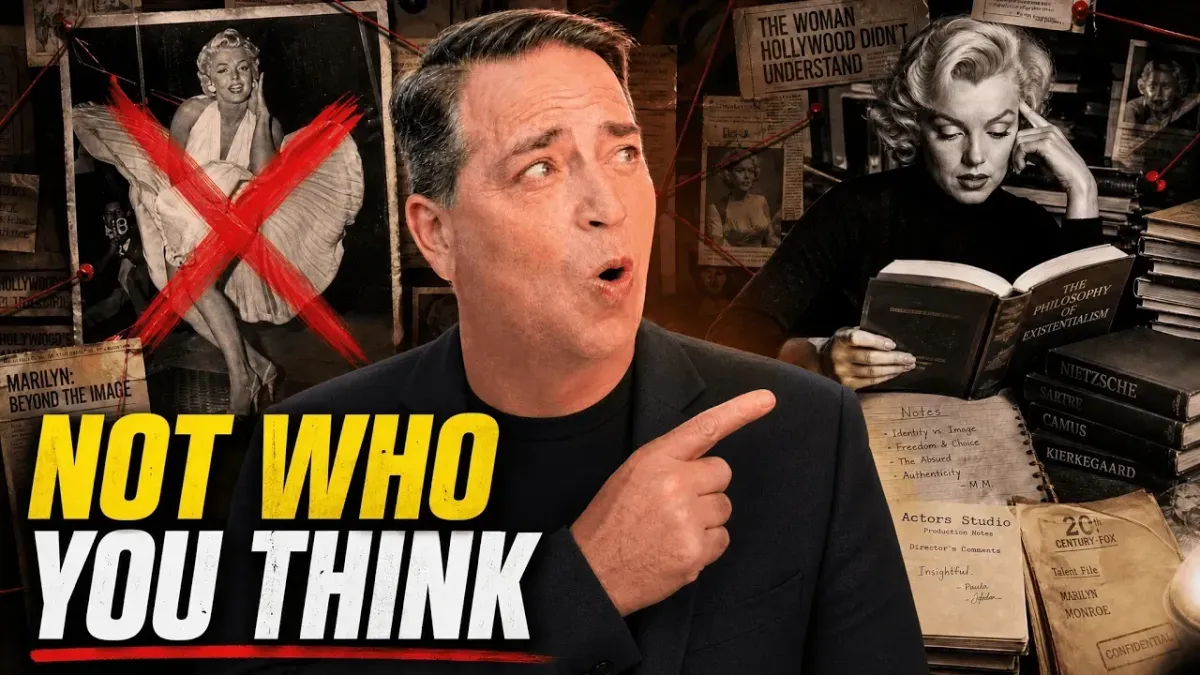
2. She was quietly, seriously well-read. Her personal library held around 400 books — not paperbacks, but Tolstoy, Dostoevsky, Joyce, Chekhov. She studied philosophy. She was close enough with Truman Capote that he described her as having one of the most interesting minds he’d ever encountered. People didn’t not know this about her. They didn’t want to know it, because it ruined the product.
3. She used her fame to lift someone else, with no credit. In 1954, when Ella Fitzgerald was being shut out of certain clubs because she was Black, Marilyn called a venue, used her name to get Ella booked, and bought a front-row table for every night of the run. No press. No speech. Ella later said Marilyn was “a little ahead of her time, and she didn’t even know it.”
4. She played dumb on purpose. Her co-star Tony Curtis complained that on Some Like It Hot she fumbled a three-word line — “Where’s the bourbon?” — dozens of times. The argument is that she wasn’t failing. She was maintaining the persona, on set, before the cameras even rolled, so the world would keep believing she really was that simple. That film is considered by the American Film Institute the greatest American comedy ever made. You tell me she didn’t know what she was doing.
The Cost
None of this came free.
She was clinically diagnosed with anxiety and what doctors then called emotional instability — and still made 30 films in 15 years while running a company and negotiating her own contracts. She married three times; none of them gave her the partnership she needed. Joe DiMaggio wanted to keep her in a box. Arthur Miller wrote her into a play without telling her.
She died in 1962 at 36, ruled a barbiturate overdose. She was, by every measure, fighting a system stacked against her from the day she was born.
Imagine what she’d have become if she’d lived into the years that were about to arrive — civil rights, the second wave of feminism. A woman that sharp, with that much leverage, walking into exactly that moment.
Instead, we got a poster.
Why This Matters
Here’s the uncomfortable question, and it’s pointed at all of us, not at her.
We didn’t just objectify Marilyn Monroe. We put her in a box because a box was easier to consume than a person. And we are absolutely still doing it — to celebrities, sure, but also to the people right in front of us.
The grocer isn’t just a grocer. The coworker you’ve already filed away has a whole interior life you’ve never asked about. We decide who someone is, then only let them show us the version that confirms it.
Marilyn understood the game so well she turned it into a weapon. Most people never get the chance, because we never let them out of the frame we drew.
The dumb blonde was the smartest person in the room the whole time.
And the room never figured it out.
If you want the full version — the marriages, the Playboy story you’ve definitely got wrong, and the hundredth-birthday exhibitions worth seeing — it’s all on this week’s episode of Sorta Sophisticated.
🎧 Listen here: