
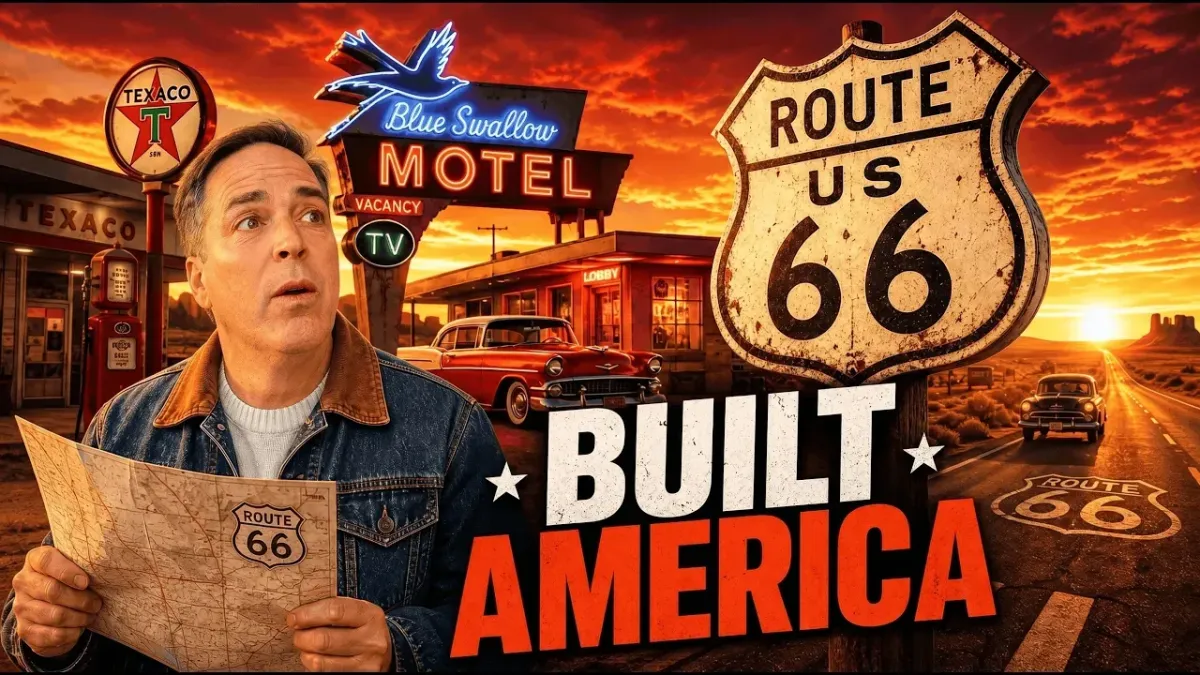
How Route 66 Invented the American Road Trip
Picture America in the 1920s. Cars have only been rolling off assembly lines for about two decades, and there are already 20 million Model Ts on the road. But here’s the problem: there’s almost nothing to drive them on. East of Chicago, the country is built out. West of Chicago? A tangled web of dirt roads, gravel paths, and dead ends, with every state running its own numbering system and its own signs. You could follow a road through Missouri and watch it simply vanish at the state line.
Then, in 1926, the federal government drew a line on a map — 2,400 miles from Chicago, Illinois to Santa Monica, California, cutting through Missouri, Kansas, Oklahoma, Texas, New Mexico, and Arizona. They called it Route 66. Within twenty years, it went from a line on paper to something like the Silk Road of America.
A Road Born From Chaos (and One Very Ambitious Businessman)
Route 66 wasn’t built from scratch. The government stitched together existing roads under one unified numbering system — same signs, same logic, coast to coast. Under the new rules, major east-west highways got numbers ending in zero, and north-south routes got numbers ending in five.
Enter Cyrus Avery, an Oklahoma businessman with no official government title but plenty of influence. Avery wanted the new transcontinental route to run straight through his hometown of Tulsa. The government offered him the number 62. He hated it. So Avery and his friend John Woodruff, sitting in a hotel in Springfield, Missouri, sent a telegram to Washington asking for the double-digit 66 instead. On April 30, 1926, the government granted it. Avery got his highway through Tulsa — and, conveniently, he owned a whole lot of gas stations along the way. Capitalism, meet the open road.
Three Waves That Made the Mother Road
What turned a numbered highway into a national icon was timing. Three massive historical waves hit Route 66 back to back, roughly a decade apart.
1. The Dust Bowl (1930s)
Just three years after Route 66 was commissioned, the Great Depression collided with the Dust Bowl. Years of poor farming practices had stripped away the deep-rooted prairie grass, so when drought hit and the winds came, black clouds of dust rolled across the plains. Millions of families from Oklahoma, Texas, and Kansas packed everything they owned and drove west toward the promise of California. Over 3.5 million Americans made the journey — most of it, in those early years, on dirt roads and even wooden planks. John Steinbeck immortalized the migration in The Grapes of Wrath and gave the highway its enduring nickname: the Mother Road.
2. World War II (1940s)
A decade later, America needed to move soldiers, families, and munitions across the country — fast. Recruits from small towns everywhere funneled onto Route 66 to reach training bases, and when the war ended, they all drove it home again. Diners expanded into restaurants. Motels grew into hotels. Twenty years of infrastructure piled up along one ribbon of asphalt.
3. The Baby Boom (1950s)
After the war came the boom — babies, a doubled middle class, disposable income, and something brand new in American life: the family vacation. For the first time, ordinary families loaded up the car and hit the highway just for fun. And where did everyone want to go? California. The American road trip was officially born in the 1950s, and Route 66 was its birthplace.
More Than a Road
Here’s the thing we keep coming back to: Route 66 wasn’t the most direct route. It wasn’t the fastest. It arguably wasn’t even the prettiest. But it was the first road that made the United States feel united — a physical thread connecting small towns, big cities, and millions of people who had never had a way to reach each other before. Families met other families. Regional cultures collided in diners and motor courts. An entire national identity — freedom, motion, reinvention — got paved into 2,400 miles of highway.
Want the full story, including the debates, the tangents, and all the fun facts? Listen to Episode 109 of Sorta Sophisticated — “America’s Most Iconic Road Almost Nobody Drives Anymore” — wherever you get your podcasts. New episodes drop every Wednesday morning.
Watch the full episode here 👇
America’s Most Iconic Road Almost Nobody Drives Anymore (Episode 109)
